Course Plan
Unit 1: Understanding Japanese Society through a Buddhist Lens
NOTE: Due to other work commitments, I will have to cancel the first class with a makeup scheduled for early November. We will miss no content, just start a week late!
October 10 & 17: A Brief History of Japanese Buddhism & The Civilizational Culture of Buddhism meets Japan’s particular cultural identity
- Introduction to Course: Read the Course Overview & Requirements & Final Project pages on this site
- Class Issue: Around 500 BCE, Shakyamuni Buddha discovered a radical new way of understanding the meaning of life, which he taught to all genders and classes. His teachings known as Buddhism spread across India and all of Asia providing a “civilizational culture” of transcending racial and national boundaries under the idea that all sentient beings may attain enlightenment. Japan has a long history as an insular, island nation. How did Japan first take in this massive “civilizational culture” distilled through both Indian and Chinese thought, and how has it adapted it to its own particular cultural identity? We will also examine Japanese Buddhism’s attempts to adapt to the modern nation state, both in grappling with western liberalism and socialism as well as “archaic” Shinto-Confucian nationalism.
- Content for 10/10: The Civilizational Culture of Buddhism meets Japan’s particular cultural identity in Ways of Thinking about Religion and Culture(PDF) Click here for related audio lecture on What Is Religion? & A Brief History of Buddhism
- Follow-up Reading: The Historical Struggle of Buddhism to Axialize Japan in the Pre-Modern Era
- Student preparation for 10/17: Show & Tell with Japanese Buddhism: bring to class on October 17 anything you can find about Japanese Buddhism, like a talisman from a temple, a book you read, a Buddhist image, etc. You don’t have to be an expert about it. Just talk about your personal impressions of it.
- Content for 10/17: A Brief History of Japanese Buddhism (PDF) Click here for the audio lecture that goes with the PDF.
Homework for 10/24: Read excerpt from Precarious Japan by Anne Allison (Duke University Press, 2013) & try to consider what are the most critical social problems in Japan today
October 24 & 31: Buddhist Social Analysis & The Present Crisis in Japanese Society, The Disconnected Society 無縁社会
- Class Issue: The Buddha summarized the goal of his teachings as the end of suffering. In order for Buddhism to be relevant for Japanese society today, it must understand what is the suffering of its people. In this class, we will learn the Buddha’s classic structure for understanding his entire teachings in the Four Noble Truths and then see how it can be used to understand the biggest social problems facing Japan, perhaps most succinctly summarized in the concept of The Disconnected Society (無縁社会 mu-en shakai)?
- Content for 10/24: The Four Noble Truths: A Buddhist Approach to understanding self and society (text only) AND A Very Short Video Lecture on the Process of the 4 Noble Truths (5 mins)
- In class video for 10/31: NHKドキュメンタリ:無縁社会 (NHK Documentary: The Disconnected Society) 45 mins. During the video take notes using the Iceberg of Dukkha from the Buddhist Social Analysis model
- Japan’s Disconnected Society (mu-en shakai) in the New Millennium
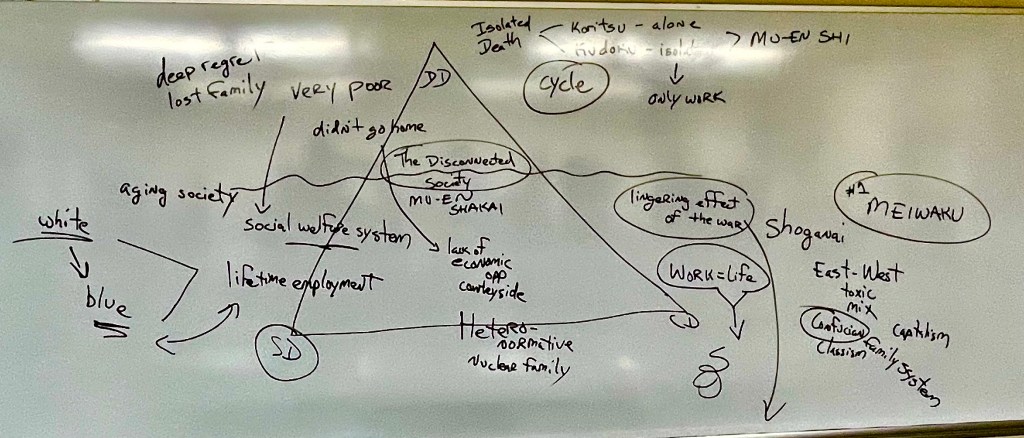
- Conclusion: Reflection on The Matrix of Social Problems in Japan
HOMEWORK for 11/7: Please read this article and have some questions ready to ask our guest speaker for next week. The Problem of Funeral Buddhism and the Crisis of Death in Contemporary Japan
Unit 2: From “Funeral Buddhism” to End-of-Life Care & Suicide Prevention
November 7: Reforming Funeral Buddhism through End-of-Life Care
- Class Issue: Japanese Buddhism today is facing a number of crises, most succinctly described in the term “Funeral Buddhism” (葬式仏教 soshiki bukkyo) which is a pejorative term criticizing monks and temples with only being concerned about doing funeral rituals for financial payment. Japanese Buddhist priests are well known for their presence after someone has died, but can they be there to support the terminally ill and their loved ones before death takes place? This class will look at how Japanese Buddhists are reviving their ancient roles and re-training themselves as compassionate guides for the dying and bereaved. We will begin to see how they are confronting the suffering of an aging society and providing support and guidance to realize the 3rd and 4th Noble Truths.
- Follow-up Reading: The Problem of Funeral Buddhism and the Crisis of Death in Contemporary Japan
- Guest Speaker: Rev. Yoshiharu Tomatsu (Secretary General of the All Japan Buddhist Federation and the World Fellowship of Buddhists, Keio graduate, Harvard M.Div.) will engage in a discussion on the Present Crisis in Japanese Buddhism and the potentials to transform Funeral Buddhism through End-of-Life Care.
- Content: The Matrix of Problems in the Japanese Buddhist World
- Content: Dying and Grieving in Contemporary Buddhism (Part I) & End-of-Life Care at the Kosei Vihara Hospice (Part II) (PDF) Click here for entire audio lecture to go with PDF
November 7 (makeup) & 14: Journey through Dukkha: The Practice of the 4 Noble Truths by the Suicide Prevention Priests of Japan
NOTE: Class at 6th period 18:10-19:40. Here is the makeup for the missed class on October 3rd. We will watch a full 90 minute documentary together (director’s cut) so bring some snacks and drinks!
- Class Issue: The two crises of Japanese Buddhism’s increasing marginalization in only taking care of the dead (soshiki bukkyo) & Japanese society’s pandemic of “disconnected death” (muen-shi) come together in the problem of suicide, which rapidly increased from the collapse of the economy in the late 1990s. Here and there, in local settings, individual Buddhist priests began to grapple with the 1st Noble Truth of suffering and encounter the suicidal who were desperate for a sympathetic person who would listen to them. By the early 2010s a non-sectarian movement of these priests was forming and today is the most powerful example of socially engaged Buddhism in Japan.
- Review: the Four Noble Truths (II): The Diamond Pyramid of Nirvana
- Remaining Content from last week: Dying and Grieving in Contemporary Buddhism & the Potential of Buddhist Chaplaincy for Japanese Society
- In Class Video for 11/7: The Departure a profile of the work of suicide prevention priest, Rev. Jotetsu Nemoto 90 mins. During the video takes notes using the Iceberg of Dukka & the Diamond Pyramid of Nirvana from the Buddhist Social Analysis model
- Follow-up Reading for 11/14: Journey Through Dukkha on the suicide prevention priests & Zen in the Mettaverse: How a 400-Year-Old Buddhist Temple is Evolving in Response to Modern Japanese Suffering by Dexter Cohen Bohn (Watts Keio class 2019) July 27, 2023
- Content for 11/14: The Problem of Suicide in Japan & Buddhist Priests Confronting the Situation (PDF) Click here for audio lecture that goes with PDF
- Additional Video for 11/14: This Man Can Rescue You from “Death by Overwork” (Buddhist follow-up on Nemoto’s work)

- Follow-up Reading for 12/5: From a Disconnected Society to an Interconnected One: Depopulation, Suicide, and Isolated Death by Rev. Shunei Hakamata 袴田俊英(秋田県の曹洞宗僧侶): 「無縁社会」から「有縁社会」へ:過疎化、自死、孤立死
FIELD TRIP! Suicide Prevention (November 11 Saturday @ 14:30-18:00): Visit Rev. Soin Fujio at his temple in Yokosuka, south of Kamakura (about 1.5 hours from Hiyoshi) to study Zen meditation and learn about suicide prevention and mental health. Limited to 20 people.
Unit 3: The Costs of Economic Development in Rural & Urban Communities & Buddhist Kaihotsu 開発 Development
December 5 & 12: Rural Decline, Migrant Laborers, Poverty & Homelessness
- Class Issue: In this unit, we begin to tie together many of the structural and cultural causes of individual suffering in the Disconnected Society (mu-en shakai). From the emptying out of the traditional farming communities in the countryside and the mass relocation of people into the cities, we see some of the early roots of the Mu-en Shakai in the two-tiered labor system of the economy and the exploitation of blue-collar labor. The Mu-en Shakai perhaps reaches its zenith with the 3/11 Triple Disaster and ongoing nuclear problem in Fukushima. This incident has presented a serious challenge to Japanese Buddhists who since the end of WWII have tried to avoid entanglement in issues perceived as political and anything critical of national development policy. In this unit, students will have the opportunity to examine a wide range of issues and responses by contemporary Japanese Buddhists trying to build an alternative society.
- Content I: Depopulation, Poverty, and Suicide in Rural Japan: From Disconnection (mu-en) to Interconnection (yu-en)
- Content II & Video for 12/5: Disposable Culture & Disposable Labor & The Nuclear Ginza 26 mins. During the video takes notes using the Iceberg of Dukkha from the Buddhist Social Analysis model.
- Content III & Video for 12/12: From the Ghetto to the Pure Land: The Activities of the Hitosaji Association & Living in Sanya: A 3rd Generation Postwar Monk 山谷に生きる:僧侶…親子三代の戦後 January 23, 2022 NHK Documentary
- Entire Content: A Buddhist Path through Rural Decline, Migrant Laborers, Poverty & Homelessness (PDF) click here for audio lecture
- Reading of Content: Rebuilding Human Bonds amidst Japan’s Disconnected Society: A Buddhist Path through Rural Decline, Migrant Laborers, Poverty & Homelessnes
- Follow-up Reading: Selections from the book Lotus in the Nuclear Sea
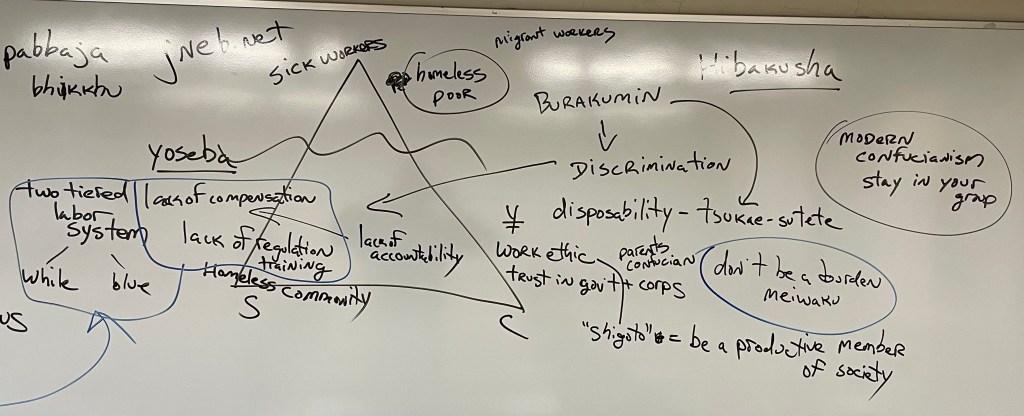
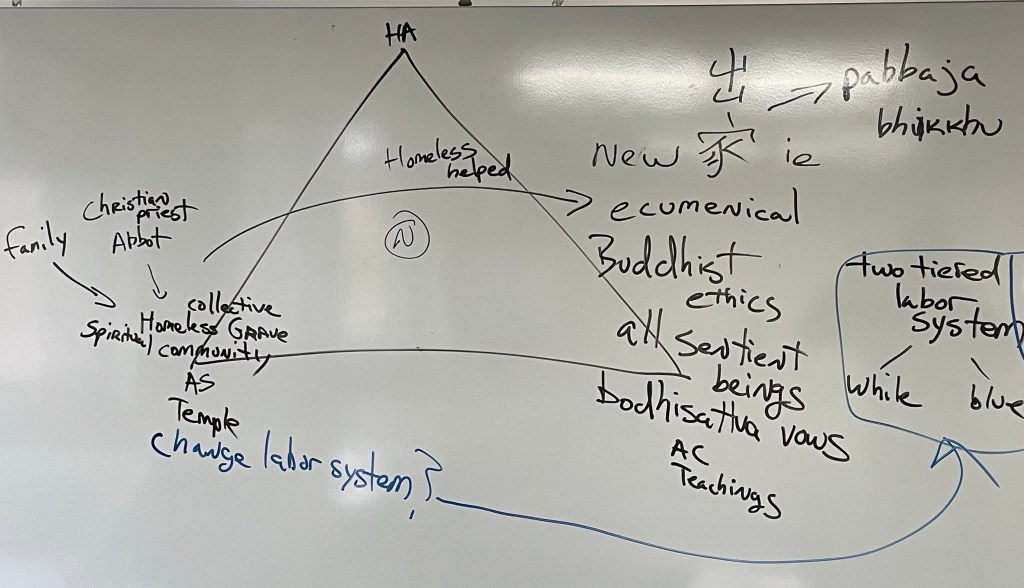
FIELD TRIP! Homeless “Patrol” with the Hitosaji Association in Asakusa (December 7 Thursday 15:30-21:30). This is a very special opportunity to learn directly from the founder and head priest of Hitosaji, Rev. Gakugen Yoshimizu, who last year was portaryed in an hour long NHK documentary. Usually this event is only held twice a month on Mondays, but because of Rev. Yoshimizu’s great generosity, he will run a private session just with our Keio students! Meet at the Mita campus courtyard at 15:30. Limited to 10 people.
December 19: Nuclear Energy & the Eco-Temple
- Class Issue: The Mu-en Shakai perhaps reaches its zenith with the 3/11 Triple Disaster and ongoing nuclear problem in Fukushima. This incident has presented a serious challenge to Japanese Buddhists who since the end of WWII have tried to avoid entanglement in issues perceived as political and anything critical of national development policy. This unit reviews their response and then looks at the inspiring work of Rev. Hidehito Okochi to build a participatory, democratic, and ecological society in Japan and abroad.
- Content for 12/19: The 1st & 2nd Noble Truths of Buddhist Engagement with the Nuclear Crisis (PDF) click here for audio lecture
- Content for 12/19: The 3rd and 4th Noble Truths of Buddhist Energy Activism: Buddhist Economics & The Choice of Development Paradigms in Japan and Rev. Okochi’s Eco-Temple Activities
- Follow-up Viewing: Buddhist SDGs in Japan & Thailand: The INEB Eco-Temple Community Development Project
FIELD TRIP! Eco-Temples & Community Development (December 16 Saturday @ 15:00-18:00) with Rev. Hidehito Okochi, Keio graduate and abbot of two eco-temples in Edogawa-ku & Bunkyo-ku. Meet at Funabori Station on the Toei Shinjuku Line at 13:15.
NOTE: Your personal reflection, bibliography, and charts for your final oral exam should be turned in before winter break on December 22. See details here.
Unit 4: From Imperial-Way Buddhism 皇道仏教 to Prayers for Peace
December 26 & January 9: December 26 class is cancelled & will be made up on January 9 during 6th period (same room 513). Have a nice holiday and New Year!
- Class Issue: In this unit, we complete the journey from the individual to the collective or social by looking at the ultimate of political and national issues, war & peace. We first take a critical look into Japanese Buddhism’s support for militaristic nationalism from the Meiji Period to the end of WWII. We then look at its complicated development since that time with many Buddhist groups becoming active in “peace activities” yet very few facing the political issues that make the real foundations of peace.
- Video for 1/9: Zen and War During the video takes notes using the Iceberg of Dukkha from the Buddhist Social Analysis model
- Follow-up Reading: Nuclear Power Is Incompatible with the Way of the Buddha / 原発は仏の道とあいいれない by Rev. Taitsu Kono (Sekai Magazine June 2012)
- Content 1 for 1/9: War Responsibility and Social Discrimination: The Problem of Moral Authority in Modern Japanese Buddhism
- Content 2 for 1/9: Lotus Sutra Social Activism in Contemporary Japan (PDF) click here for audio lecture plus videos of previous peace demonstrations with Nipponzan Myohoji (Note: the PDF is slightly more up to date)
FIELD TRIP! TBA late December Visit to the Nipponzan Myohoji center in Shibuya and to interview the monks about non-violent civil disobedience and peace walks. Nipponzan Myohoji is the most active postwar Japanese Buddhist group in peace actions not only inside Japan but all over the world. There will also be a chance to learn about and praticipate in their practice of venerating the Lotus Sutra through chanting with hand held drums.
Unit 5: A Buddhist Vision for Japan
January 16: From Social Dukkha to Social Nirvana
- Class Issue: In this last unit, we will take a final, comprehensive view of the Iceberg of Dukkha in Japan and then look at the potentials of Buddhism to offer a future vision and path for Japanese society, specifically through the work of Prof. Jun Nishikawa, the late professor of development economics at Waseda University
- Student Preparation for class: Choose ONE each of a 1) Holding Action, 2) Alternative Structure, 3) Shift in Consciousness that we have seen in this class and be prepared to share in class
- Group Work: Review the various activities by Japanese socially engaged Buddhists to engage in holding actions, and build alternative structures and shifts in consciousness (culture).
- Content: The Final Iceberg of Japanese Dukkha & the Potential of Japanese Socially Engaged Buddhism (PDF) click here for the audio lecture Note: The PDF at the beginning is more up to date
- Follow-up Reading: The Choice of Development Paradigms in Japan after the 3:11 Fukushima Nuclear Disaster by Jun Nishikawa
January 23 cancelled & will be made up on January 17 during 6th period (same room 513). Reviving the Spirit of Kamakura Buddhism for 21st Century Japan
- Class Issue: In this class, we will delve into the Zen, Pure Land, and Lotus Sutra teachings that form the core of the Kamakura Buddhist Reformation to examine their pitfalls and potentials for contemporary Japanese society.
- Presentation: The Kamakura Axial Revolution: From Pure Land’s Elevation of the Common Person to Zen’s Actualized Enlightenment to Nichiren’s Liberation of the World
- Conclusion: A Commentary on the Heart Sutra, the “Perfection of Wisdom” (Prajna Paramita)
 Contemporary Buddhism in Japan & Asia