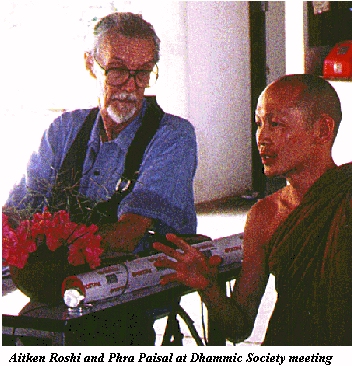
In 1992, at the third annual INEB conference, a group of thinkers and theorists within INEB formed a small peer group called the “Buddhism and Social Analysis Group”. We continued to meet every year at the INEB conference and to exchange papers and letters throughout the year on engaged Buddhist social theory. We created an international meeting in Thailand in 1995 called “The Dhammic Society: Towards a Vision of Engaged Buddhism”. As this was the group’s first formal meeting, the goals and results were of a general nature. The number of participants was quite large, around 50 people from 20 nations. We were able to map out some of the key social issues which we felt engaged Buddhist needs to address. They were:
- the tradition & interpretation of Buddhism in the modern world
- the discrimination & oppression of women
- the collapse of community & family structures
- economic exploitation
- structural violence
- education
Since this meeting, a core group of us has continued on with the activities of publishing the talks made at the meeting (Entering the Realm of Reality: Towards Dhammic Societies), expanding the network of engaged Buddhist thinkers, and forming smaller discussion forums in particular countries. In preparing for the next international meeting to be held two years after the 1995 meeting, the group deepened its goal of bringing a mature engaged Buddhist social theory into mainstream social discourse within both Buddhist and Western countries. This vision is the Think Sangha.
Vision and Goals
As our group has been engaging in various social issues, we are continually confronted with the challenge of mainstream ideas which often go counter to Buddhist teachings; for example, that economic and material development must always expand, or that humankind should use natural resources for its own greater glory. It is clear that many of the mainstream values of today were not so in the past. They have become mainstream through the work of smaller groups of individuals to advance them, make them known and work for their acceptance. An example is a small group of conservatives in the United States in the 1960s. With other groups, they successfully defended capitalism against the attacks of 60s radicals and have worked to make capitalism an accepted value in our societies today.
Today, one of the most disturbing values of this modern, capitalist society which has spread throughout the world is that religious, moral and spiritual ideas are private matters and have no place in public dialogues over political problems, world trade, or social issues such as education. This value not only reminds religious groups to stay quiet but also belittles any attempts by such groups to enter public debate. Typically, Buddhists have bought into this mainstream value and tend to ignore all types of social problems. Buddhists tend to neglect the social forms of the sufferings (e.g. structural greed and theft in investment banking) which they feel are so important to confront on a personal level. In Buddhism, ideas may not be enough for wisdom, compassion, and liberation, but in the world they can have consequences and develop into societal values.
If we accept this proposition, then what can we do to generate and disseminate ideas that have consequences? How can we support, encourage, nurture, and promote Buddhist intellectuals? The focus of the Think Sangha is to realize this potential for the power of ideas while attempting to re-assert the role of moral, religious and spiritual ideas into the realm of public discourse. Traditionally, these ideas had always been part of the public realm in order to guide the political, economic and social relations of humans and also the relations between humans and other life forms on the planet. The platform and goals of the Think Sangha are:
- to provoke thoughtful Buddhist analysis & comment on the pressing issues of our day
- to develop engaged Buddhists tools for social & cultural analysis
- to introduce the thinking & activist worlds to the perspectives of engaged Buddhism
- to change the way people talk about & respond to the world, that is, to bring moral & spiritual perspectives back to the center of economic, political, & social debate
- to be a powerful moral voice throughout the world
Methodology
While theory is important and necessary, it must be grounded in the personal and real. In our analytical-critical work, the Think Sangha seeks to avoid the linear, abstract, pseudo-objectivity of mainstream male academia. Instead, we seek to inter-weave history, politics, personal and family stories, theory, and spiritual insights into a holistic model of social analysis. Further, in such theoretical work there is the danger of ideology. Many Buddhists make an inflexible ideology of their moral beliefs. Ideology sometimes appears in the form of a covert secularism. For example, in what is supposed to be Dhammically informed debate about abusive Buddhist teachers, it is not unusual to find secular feminist ideology being used rather than Buddhist feminist insight unraveling confrontation.
Ideology needs to be “emptied” before Dhammic use, so that it becomes a playful concept. Our ideas should avoid taking on the sense of absolute truth, and we should learn that our differences can be fruitful, fraternal, and valuable personal practice. With these ideas in mind, we are forming a “sangha” as our foundation. Our sense of “sangha” is a community of people who interact, challenge, and support one another in the spirit of transformation; rather than a “think tank”. To be an engaged Buddhist Think Sangha, we must avoid certain pitfalls. Firstly, there must be no separation between theory and practice; the two are seamlessly inseparable. Secondly, abstraction and real life events must be interwoven in the work, again seamlessly. By building ourselves in such a way, we may better avoid the pitfalls of static, patriarchal social theory and ideology while developing a dynamic spiritual and moral vision that is meaningful and practical to individuals in reuniting the public and personal.

