Course Plan
September 25: Note special time change ONLY for this week from 2nd period at 10:45 to 6th period at 18:10
Introduction to class and Ways of Thinking about Religion and Culture
- Course Introduction
- Lecture and Discussion on Ways of Thinking about Religion and Culture
- Is religion about what you believe OR how you live? Is religion about what happens after death/heaven/salvation OR how you find happiness and lead a good life today?
- Is religion a failure or a problem as a means for legitimizing racism, sexism, and nationalism OR a way of bringing together people of many different backgrounds to be able to live with common morals and ethics?
Homework for 10/2:
Please e-mail me at wattsj[AT]keio.jp to confirm your contact for the course!
1) Show and tell with Japanese Buddhism – bring in an image, an article or anything you can find about Japanese Buddhism and be prepared to talk about it for a few minutes. Even if you don’t know anything factual about this thing, you can simply talk about your feeling about it.
2) Read the selections from Ways of Think of Eastern Peoples by Hajime Nakamura (available on the Readings section of the homepage)
3) Identify areas of interest for class project
1) Human Relationships I: Dying and Grieving
2) Human Relationships II: Alienation & Suicide
3) Development I: Economic Development & Community
4) Development II: Economics, Energy, and Environment
5) Politics I: Nuclear Power and Peace
6) Politics II: War and Peace
October 2: A Brief History of Japanese Buddhism & The civilizational culture of Buddhism meets Japan’s particular cultural identity
- Show and tell with Japanese Buddhism
- Lecture: A Brief History of Japanese Buddhism
Homework for 10/9:
1) What are the biggest social problems in Japan? Do a little research and collect some media.
日本人学 生の特別宿題:三つ大変日本社会問題を発掘してください。
具体的問題と構造的背景と文化的背景を考えてください。
2) CHOOSE an area of interest for class project (for details see Field Trips page)
1) Human Relationships I: Dying and Grieving (November 6 or 19 Carer’s Cafe with Rev. Yoshiharu Tomatsu)
2) Human Relationships II: Alienation & Suicide (November 24 Rev. Soin Fujio)
3) Development I: Economics, Alienation & Suicide (December 2 Hitosaji Association feeding the homeless)
4) Development II: Economics, Energy, and Environment (December 7 Rev. Hidehito Okochi’s Eco Temple)
5) Politics I: Nuclear Power and Peace (choice of #4 or #6)
6) Politics II: War and Peace (November 3 peace demonstration with Nipponzan Myohoji)
October 9: Buddhist Social Analysis & The Present Crisis in Japanese Society
- Introduction: The Four Noble Truths: A Buddhist Approach to understanding self and society
- Group work: Doing a Buddhist Social Analysis of Japan
- Conclusion: Reflection on The Matrix of Social Problems in Japan
- SPECIAL EXTRA SESSION (optional) lunchtime 12:15-13:00: Meet Ted Mayer, the Director of the School of English for Engaged Social Service (SENS) founded by the International Network of Engaged Buddhists (INEB) based in Thailand. Its annual 3 month course (Jan-March) is a great way to develop a career in social justice and spiritual activism!
- October 8: Public Event with Ted Mayer open to all
Homework for 10/30: Read excerpt from Precarious Japan by Anne Allison (Duke University Press, 2013)
NOTE: Classes for October 16 & 23 are cancelled and will be made up on November 13th as a double class during 2nd & 3rd periods from 10:45 & 13:00
October 16 –> October 30: The Present Crisis in Japanese Society: The Disconnected Society 無縁社会
- Video: NHKドキュメンタリ:無縁社会 (NHK Documentary: The Disconnected Society – Muen Shakai)
Homework for 11/6:
- prepare some ideas for the 3rd and the 4th Noble Truth as it applies to Japanese society and think of how Japanese Buddhism could be a part of solving the dukkha of Japanese society.
- Read the first third of Reconstructing Priestly Identity and Roles in Contemporary Japan and the Development of Socially Engaged Buddhism (PDF:WattsOkanoJSEB)
FIELD TRIP: November 3 (Sun.): (10:15-14:30) Visit to the Nipponzan Myohoji center in Shibuya and then joining their monks, nuns, and laypeople in front of the national Diet building in Kasumigaseki to join a wider popular protest to preserve Article 9 of Japan’s constitution which forbids an active military and the right to wage war. Protest starts at 13:00 and ends at 16:00, but students can leave after 14:30. Unlimited
October 23 –> November 6: The Present Crisis in Japanese Buddhism
- Group work: Envisioning a healthier Japan through the 3rd & 4th Noble Truths
- The Pyramid vs. The Web: How Cosmology Reflects Power in Society
- The Matrix of Problems in the Japanese Buddhist World
Homework for 11/13: Read The Potential of Rinsho Buddhism and Developing Buddhist Chaplaincy in Post 3/11 Japan by Rev. Hitoshi Jin
FIELD TRIP November 6 (Wed.) 13:30-16:00 The Carer’s Cafe at Genkaku-ji Temple, a Jodo Pure Land temple that hosts a Carer’s Cafe for families of the elderly and local community officials to support such families in caring for their dying loved ones. Buddhist temples have a traditional role which could be revived in offering community care to the dying. Central Tokyo, Kasuga Station, Mita Line Limited to 6 people
October 30 –> November 13 2nd period @ 10:45: Human Relationships I: Dying and Grieving in an Aging Society & the Potential of Buddhist Chaplaincy
- Opening student led discussion on death and dying (1st&2nd NTs): What happens after death? Does the way you die affect what happens after death? Does suicide lead to hell or is it an escape from suffering in this world? Does science or religion offer the better explanation of how to deal with end of life?
- Lecture: Dying and Grieving in Contemporary Buddhism
- Student led evaluation of movement (3rd&4th NTs)
- Conclusion: The Emergence of Buddhist Chaplaincy Around the World & Its Potential for Japanese Society
Homework for 11/13: Read Journey Through Dukkha on the suicide prevention priests
November 6 -> November 13 3rd period @ 13:00: Human Relationships II: The 1st Noble Truth of the Suicide Prevention Priests
- Video: The Departure – a profile of the work of suicide prevention priest, Rev. Jotetsu Nemoto
Homework for 11/27: Read the article: From an Disconnected Society to an Interconnected One by Rev. Shunei Hakamata
Special Meditation Time: November 20 (Wed.) 16:00-18:00: There will be two sessions, each around 40 minutes with a 20 minute break in between. The second session will begin at 17:10 if you only want to join then. Meet in front of the temple, Shinko-in temple, at the foot of Tokyo Tower. Optional Indian dinner afterwards!
FIELD TRIP: November 24 (Sun.) 14:30-17:00: Suicide Prevention Priest Rev. Soin Fujio at his temple in Yokosuka, south of Kamakura. Meet at Zushi station at 13:45. Limited to 20 people
November 27: Development I: Economic Development & Community – from the 2nd to 4th Noble Truths with the Suicide Prevention Priests
- Opening whole group discussion on The Departure (based on your notes using the 4 NTs)
- Lecture: The Problem of Suicide in Japan & Buddhist Priests Confronting the Situation
- Whole group discussion: Field Trip students reflect on the field trip and make a critique of Fujio and the priests’ movement
- Lecture Part II: Community building with the suicide prevention priests
- Opening lecture on community collapse in rural Japan and the roots of urban homelessness – an Analysis by Rev. Shunei Hakamata (1st&2nd NTs)
- Lecture on the Hitosaji Association by Akinori Takase & Student led evaluation of the association (3rd&4th NTs) postponed until January
- Video: The Nuclear Ginza
Homework for 12/11: Read A Futuristic Priest Whose Time Has Arrived
FIELD TRIP: December 7 (Sat.) 15:00-19:00: Rev. Hidehito Okochi’s TWO Eco-Temples in Edogawa-ku & Bunkyo-ku.
FIELD TRIP: December 9 (Mon) 17:00-21:30: Homeless “Patrol” with the Hitosaji Association in Asakusa 17:00-21:30. Meet at the Mita campus courtyard after 4th period at 4:15. Group 1 limited to 10 people
December 11: Development III: Nuclear Energy & the Eco-Temple
- Lecture 1: The 1st & 2nd Noble Truths of Buddhist Energy Activism after Fukushima
- Students group work: What is the best path to climate justice?
- What is the best path to climate justice? Is it through individual lifestyle change from the ground up? OR political protest and structural reform from the top down?
- What’s the best way to slow global warming? Put all resources into clean energy even though it may not deliver enough energy OR continue to expand nuclear energy as an available fossil fuel alternative?
- Lecture 2: The 3rd and 4th Noble Truths of Buddhist Energy Activism: Buddhist Economics & The Choice of Development Paradigms in Japan and Rev. Okochi_s Eco-Temple Activities
Homework for 12/18: Read Nuclear Power Is Incompatible with the Way of the Buddha / 原発は仏の道とあいいれない by Rev. Taitsu Kono (Sekai Magazine June 2012)
December 18: Politics I: War and Japanese Buddhism
- Video: Zen and War and Zen and War Video Notes
Homework for 12/25: Read Nichiren’s Activist Heirs: Soka Gakkai, Rissho Koseikai, Nipponzan Myohoji by Jaqueline Stone & Which Way to Peace? The Role of Japanese Buddhism in Anti-Nuclear Civil Protest by Jonathan Watts
FIELD TRIP: December 23 (Mon) 17:00-21:30: Homeless “Patrol” with the Hitosaji Association in Asakusa 17:00-21:30. Meet at the Mita campus courtyard after 4th period at 4:15. Group 2 limited to 10 people
December 25: Politics II: Peace and Japanese Buddhism
- Opening student led discussion on militarism and Japan (1st&2nd NTs)
- Lecture on Lotus Sutra activism in Contemporary Japan & watching videos of previous demonstrations with Nipponzan Myohoji
- Student led evaluation of Myohoji’s activities (3rd&4th NTs)
- The Pyramid vs. The Web: How Cosmology Reflects Power in Society
January 8: Buddhism and the Future of Japan
- Lecture on the Hitosaji Association by Akinori Takase & Student led evaluation of the association (3rd&4th NTs)
- Lecture on Lotus Sutra activism in Contemporary Japan & watching videos of previous demonstrations with Nipponzan Myohoji & Student led evaluation of Myohoji’s activities (3rd&4th NTs)
January 15: Consolidation of Themes & Preparation for Final Paper
- Class evaluations
- The Final Iceberg of Japanese Dukkha & the Potentials of Japanese Socially Engaged Buddhism
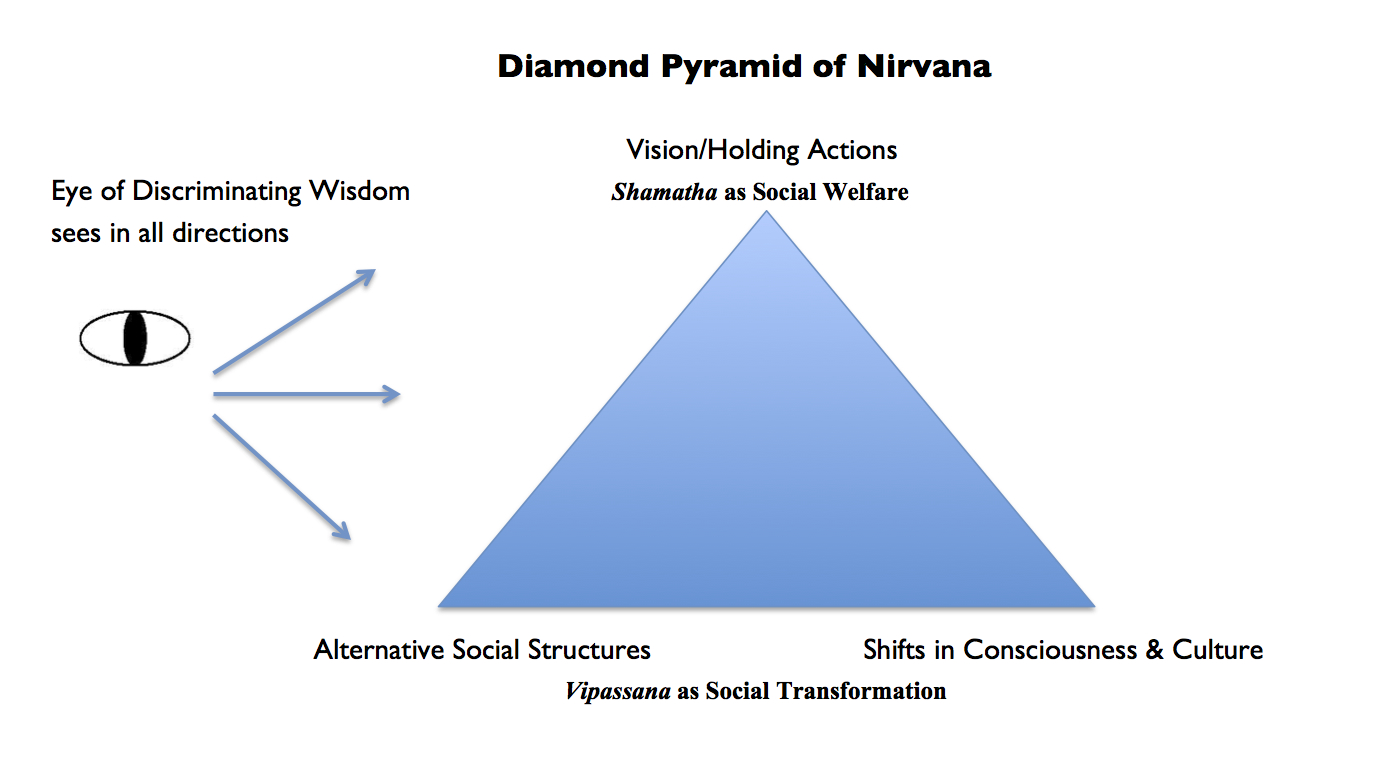
- Diamond Pyramid of Nirvana: Review the various activities by Japanese engaged Buddhists to engage in holding actions, and build alternative structures and shifts in consciousness (culture). Add some of your own recommendations in a different color.
- Dharma Teaching on Zen & the Heart Sutra and other Buddhist teachings
Final Homework: Turn in your final paper anytime before or on January 21 at midnight see details on Final Projects page
 Contemporary Buddhism in Japan & Asia
Leave a comment