by Jonathan S. Watts
Keio University (Tokyo), Lecturer
International Network of Engaged Buddhists (INEB), Executive Committee
The Four Noble Truths are considered one of the core teachings of the Buddha which he taught in his very first sermon at the Deer Park near Benares to the five ascetics with whom he had closely practiced. They are usually presented as:
- Life is inherently one of suffering or dissatisfaction (dukkha)
- The cause of this suffering and dissatisfaction is craving and desire (samudaya)
- The end of this suffering and dissatisfaction is liberation or enlightenment (nirodha)
- The way to realize this ending of suffering and dissatisfaction is the Buddha’s teaching, specifically the Noble Eightfold Path (magga)
For most Buddhists, the fourth of these truths is of most interest as it encompasses the whole of not only the historical Buddha Shakyamuni’s teachings but also the entirety of the Buddhist tradition after him. Many find interest in the second, specifically the Buddha’s teachings of how craving arises in the mind through the cycle of dependent origination (paticca samuppada). Meanwhile the first and third truths generally stand as statements of fact uttered through the undisputed insight of the Buddha.
In this way, most Buddhists enter the dharma and begin their practice on the entirely wrong foot. They begin their Buddhist path by receiving the dharma as a series of ontological truth statements about the nature of existence. I am not doubting the veracity of these four truths, but rather questioning how we go about handling them. Throughout the Buddhist tradition, there has been a tendency to ontologize (to make truth statements about the inherent existence of the world) various aspects of the dharma. This can be seen in the systemization of the Buddha’s sutra discourses in the Abhidharma and in the extended amplifications of the Yogacara teaching of “mind only” or “One Mind”. There can be certain merits in establishing a correct view (samma ditthi) of the dharma as the Buddha affirms in the first practice of the Noble Eightfold Path. However, the Buddha clearly pointed out major pitfalls in getting caught in conceptualization, such as his warnings about conceptual proliferation (prapanca)[1] and clinging to views (ditthupadana), the second of the four types of clinging (upadana) which lead to ego birth through dependent origination.
I would argue that the problem with this approach is practitioners tend to get caught up in inquiries concerning what is, rather than in a practice devoted to exploring how to. In the former tract, the way to realize the ending of suffering turns into a conceptual activity which culminates in locating the right view of phenomena. In the latter, one’s entire being (mind, heart, body and breath) are engaged in an experiential and ethical praxis with other sentient beings to live a way of life based in non-harming and compassion. The great Vietnamese monk Thich Nhat Hanh conspicuously devotes attention to this problem in the first three of his 13 Tiep Hien Precepts:
- Do not be idolatrous about or bound to any doctrine, theory, or ideology, even Buddhist ones. All systems of thought are guiding means; they are not absolute truth (author’s emphasis).
- Do not think that the knowledge you presently possess is changeless, absolute truth. Avoid being narrow-minded and bound to present views. Learn and practice non-attachment from views in order to be open to receive others’ viewpoints. Truth is found in life and not merely in conceptual knowledge (author’s emphasis). Be ready to learn throughout your entire life and to observe reality in yourself and in the world at all times.
- Do not force others, including children, by any means whatsoever, to adopt your views, whether by authority, threat, money, propaganda, or even education. However, through compassionate dialogue, help others renounce fanaticism and narrowness. (Nhat Hanh, 1987)
I would contend that the Four Noble Truths in particular and most of the Buddha’s dharma in general is a series of “scientific” injunctions. As injunctions, they call us to investigate, experience and, importantly, verify amongst a larger community (sangha) of fellow investigators. This is most clearly seen in the Buddha’s own words that the Dharma is to be seen here & now (sanditthiko), timeless (akaliko), inviting all to come & see (ehipassiko), and to be seen by the wise for themselves (paccattam veditabbo). When we grab the Four Noble Truths from this end its full liberative potential may be realized. So let us re-examine the Four Noble Truths from this basis:
The Three Levels of the Four Noble Truths
- Conceptual (conventional) – truth statements about existence; can be helpful in establishing Right View (samma ditthi)
- Analytical (individual and social level) – a framework for addressing problems and solving them; important for doing social analysis
- Experiential – a practice for developing ethical and compassionate action; a method for personal and social liberation
The 1st Noble Truth
- Conceptual
There have been numerous different attempts at translating the original Buddhist term dukkha into English (and into other foreign languages). “Suffering” is perhaps the most common. However, it is largely inadequate since when it is expressed in this conceptual and ontological way, it tends steer, especially beginners, into a nihilistic understanding of existence. This has lead numerous critics of Buddhism to view it as a spirituality of negativity. In a world already awash with cynicism over political corruption, economic inequality and religious intolerance, people aren’t interested in more negativity – plus it doesn’t resonate when one is enjoying a nice drink and talking with a good friend.
“Dissatisfaction” is perhaps a better rendering as it tends to connect us to the Buddha’s core teaching of impermanence (anicca). Of course, life can be enjoyable, but it never stays that way forever. In this way, we are always caught in a state of perpetual dissatisfaction or “You can’t always get what you want!”. It never lasts. This understanding can also lead us deeper into the fundamental angst or lack we experience as sentient beings. This is the dukkha of not-self (anatta) – that try as we may, we can never find permanent and satisfactory grounding for an independent self.
While “dissatisfaction” is perhaps adequate, I like to think that we can keep the word dukkha in tact and add it as a new term to our vocabulary. There are numerous concepts and terms in Buddhism that are not only new to Westerners but also Indians themselves as the Buddha had a way of redefining common terms in a brand new way (i.e. karma is ethical action, not ritual action or fate). While it is important not to lose track of the original meaning of dukkha (in the way that term “zen” has today), it can give us a new conceptual method for understanding the deep existential angst or lack based in not-self that many western philosophers have tried to comprehend.
- Analytical
Now if we begin to get interested in going beyond concepts and actually confronting our dukkha-laden existence, we can use the 1st Noble Truth as the entry point for framing a situation. Not all situations are problematic. Some things work quite well, so the 1st Noble Truth is not a tool we will use for all situations and at times. This reinforces the point that the 1st Noble Truth should not be understood as an ontological statement about the world. However, the world and our lives are sufficiently problematic and imperfect enough that we can certainly find ample usage for framing numerous experiences through this first injunction of dukkha. As an ontological statement, the 1st Noble Truth is: Life is inherently one of suffering or dissatisfaction. However, as an analytical tool, we could reframe it as: “What is the suffering at hand?” or simply, “What is the problem?” This is an invitation or injunction to not only see deeply but to feel deeply; to open our eyes and look fully at the problematic situation at hand. This approach flows naturally and is essentially inseparable from the third approach below.
- Experiential
Without this third approach, the second approach to dukkha is still too tempered by the intellectualism of the first conceptual approach. As in a think tank, we can sit around and look at someone else’s suffering from a point of dispassion. Dispassion and equanimity (upekkha) might be core values in the Buddhist tradition but not when they preclude and negate compassion and loving kindness. This kind of overly analytical and disconnected approach to problem solving is what allows us to rationalize the harming of others through economics (which create poverty), politics (which create war), and religion (which create delusion). Thich Nhat Hanh has precisely outlined this experiential approach to dukkha in the fourth of his 13 Tiep Hien Precepts:
Do not avoid contact with suffering or close your eyes before suffering. Do not lose awareness of the existence of suffering in the life of the world. Find ways to be with those who are suffering by all means, including personal contact and visits, images, sound. By such means, awaken yourself and others (author’s emphasis) to the reality of suffering in the world.
This approach, of course, includes looking deeply into one’s own suffering which is perhaps the more difficult of the two to confront. The fuel on which many social activists and charity workers run is the flight from their own internal dukkha and the desire to redeem that dukkha by serving others. While this is not something to condemn, it is a way that will be incomplete without serious devotion directed towards the internal conditions of dukkha which condition outer forms of dukkha.
In this way, the third experiential approach to dukkha can be framed in exactly the terms Thich Nhat Hanh uses, “Do not avoid contact with suffering or close your eyes before suffering.” While he has sufficiently emphasized the outer and social application of this injunction, here we might emphasis the inner.
This inner engagement with dukkha has two important aspects. The first is the discipline to sit with and endure dukkha. The very nature of dukkha pushes us to flee it. The mind and body squirm and turn away. We run for refuge from the deluge – to various pernicious medicines such as TV, alcohol, sex, fame, and especially today, the soma of hi-tech pharmaceuticals. Yet again, we must remind ourselves that the Buddha taught dukkha as an injunction, an invitation to practice. Instead of turning and fleeing from our dukkha, we must go at it head on. This is something we can come to appreciate in meditation practice – either in the endurance it requires to sit through leg pain or in the perseverance to practice during times of depression. In both of these situations, our teachers remind us to sit and observe the mind/heart patiently, allowing sensations, feelings, opinions and the lot come and go through the process of impermanence. It is sort of a holding pattern. We hold the dukkha patiently and watch it and study it. As we study, we begin to learn about its nature – to see the causes and conditions which have given rise to it and how it is inherently impermanent (anicca) and without essential nature (anatta). This is the practice of dukkha.
This practice is perhaps the most stringent and ascetic of all Buddhist practices, even if one is not in an isolated forest but on a soft cushion in a warm home. It is not without its dangers, for as we have seen in streams of existentialism, just practicing the first two noble truths can lead to nihilism, despair, and even suicide. This is where the second important aspect of the practice of dukkha enters. While we must inevitably wrestle with and endure our own dukkha, we also need to seek out support from others in our struggle. The Buddha made this a core of his teaching, most conspicuously in the creation of the four-fold sangha but also in his emphasis on spiritual friendship (kalyanamitra) as a key support to the practice of the way. In the way that the Buddha always focused on the inner, ethical meaning of ideas over the outer, formalistic meaning, we need to assert the deeper meaning of sangha as a group or community of kalyanamitra, rather than as just the ordained monastic order.
On a more basic level, we can find such community outside of religious groups, simply in our circle of family and good friends. However, an authentic spiritual community can provide a more disciplined and effective process to sharing suffering than the ways we often use today, such as over drinks or on voyeuristic television talk shows. In a well structured group setting, religiously focused or not, sharing and story telling among participants is essential in creating an atmosphere of right speech and deep listening and in empowering all members to participate actively and equally. In this way, this second aspect of the practice of dukkha can build a larger process of group work which creates the foundation for social transformation – the resolution of suffering as a shared process among interdependent beings.
In any group process, there will inevitably be discrepancies in power, perhaps due to ethnicity, class, gender, age, or position within the group. No matter how well a group has articulated a philosophy of equality, there will be a disjuncture between this philosophy and its practice due to such previously established power imbalances. In this way, story telling is an essential first act, because it exposes the topology of power through articulation of historical and social contexts. When every participant is given time to express her- and his-story, we can begin to become aware of where margins are drawn in a community or society and where different actors reside in the expression of power in the community or society. Such an exposure of power dynamics immediately sensitizes us to issues of justice and injustice. It also creates a foundation in the reality of lived experience where espoused values, principles and concepts are transformed or deformed into customs and traditions. This is one very important method for overcoming the limitations of the first conceptual approach to dukkha. The Buddha dharma as a wonderful set of inspiring ideas or concepts is just not enough for creating authentic personal and social transformation. These concepts and ideas must be enacted and brought to life.
The act of story telling provides not only an instrumental purpose of exposing injustices, but also acts therapeutically. Ouyporn Khuankaew is the Director of The International Women’s Partnership (IWP) which conducts training workshops across Southeast and South Asia in women’s leadership, empowerment and non-violence. She has found that,“For us women, speaking out about how we are oppressed is breaking the silence, which is the first step of liberation.”(Khuankaew, 2003) For the speaker, story telling serves as an act of bearing witness and of gaining recognition after a long period of existing in silence and marginalization. For the listener, it can wake up feelings of remorse and compassion in bearing witness to the real pain of others. In this way, the act of story telling serves as a first step in an overall ethical praxis, because when every participant is given equal time to share his/her experience and feelings, a bond of trust and collectively can be created by which the difficult work of critical dialogical communication can begin. The next step in our process is the 2nd Noble Truth which develops certain kinds of important analytical work. However, before that work can begin we must be grounded here in the 1st Noble Truth – the experiential practice of dukkha.
The 2nd Noble Truth
- Conceptual
As we stated at the beginning, the 2nd Noble Truth is the cause of dukkha is craving and desire. From a Buddhist standpoint, it is important to note that this suffering is not caused by the force of evil – often externalized in the belief in demons and malevolent spirits and, of course, in foreigners, unbelievers, and various other external threats. As related in the events of the night of his awakening, the Buddha’s liberative experience was based in his insight into the law of conditionality or dependent origination (paticca samuppada). From this insight, he saw that dukkha arises most conspicuously from craving (tanha) and clinging (upadana). However, the source of this craving and clinging is not the force of evil but of ignorance (avijja). This difference has enormous ramifications for how we go about solving the cause. Evil is generally seen as a force which must be totally annihilated by any means necessary, while ignorance is something which can be solved through education and more thoughtful compassionate action.
Another essential part of Buddhist conditionally is the insight that this ignorance arises form various causes and conditions. This is directly tied to Buddha’s insight of impermanence (anicca). This insight of impermanence means that the universe is a dynamic place of change. Because of the dynamism, ignorance, craving , clinging and its malevolent results are not due to some inherent essence or character – which directly reflects the other core insight of not-self (anatta). The is no original, pernicious, ignorant substance that can be seen to be lodged in the being of another person and thereby be the reason for attacking them out of righteousness. Further, the dynamism of impermanence and not-self undercuts the conventional Buddhist understanding of dependent origination, which sees that ignorance from previous lifetime conditions craving and clinging in this lifetime leading to rebirth in a miserable existence in the future. While past actions certainly have influence on the present, they do not predetermine it. Ethical action – the true meaning of karma – is the Buddha’s way for short-circuiting the power of craving and clinging and turning ignorance into wisdom.
- Analytical
In the analytical approach to the 1st Noble Truth, we asked the simple question: “What is the problem?” However, we tempered this with an experiential approach which pushes us to look more deeply into the problem and to experience it as our own. This is the full practice of the bodhisattva way of compassion – to feel another’s suffering as one’s own. From this experiential standpoint, we develop a much richer and keener sense of the causes and conditions behind the dukkha. As we become intimate with the dukkha as our own dukkha, we can understand the history and context of it beyond just the conceptual level of facts and events. In this way, we have prepared the ground, like plowing a field, for a much richer investigation of causes and conditions. So the 2nd Noble Truth on this level can be expressed in the question: “What are the causes and conditions of the problem?”, or simply, “Where does it come from?”
Specifically, we want to investigate causes and conditions which go beyond the individual and pertain to the social. Humans are fundamentally and inherently social. Procreation is a social event – the union of two people to create a third and sometimes a fourth and fifth! One of the most pernicious uses of religion over the history of humankind is to lodge the cause of suffering in the individual. Using a conventional understanding of conditionality in which evil and ignorance are lodged within a self or soul, individuals have often been blamed as the sole cause of their dukkha. For example, blacks are lazy which is why they are poor; women are weak and lustful which is why they need to be controlled; tribals are uneducated which is why they need “development”, etc.
A social analysis is therefore essential to uncover the structural and cultural causes and conditions which lead to the direct experience of suffering. A simple way to envision this process is in the form of an iceberg.
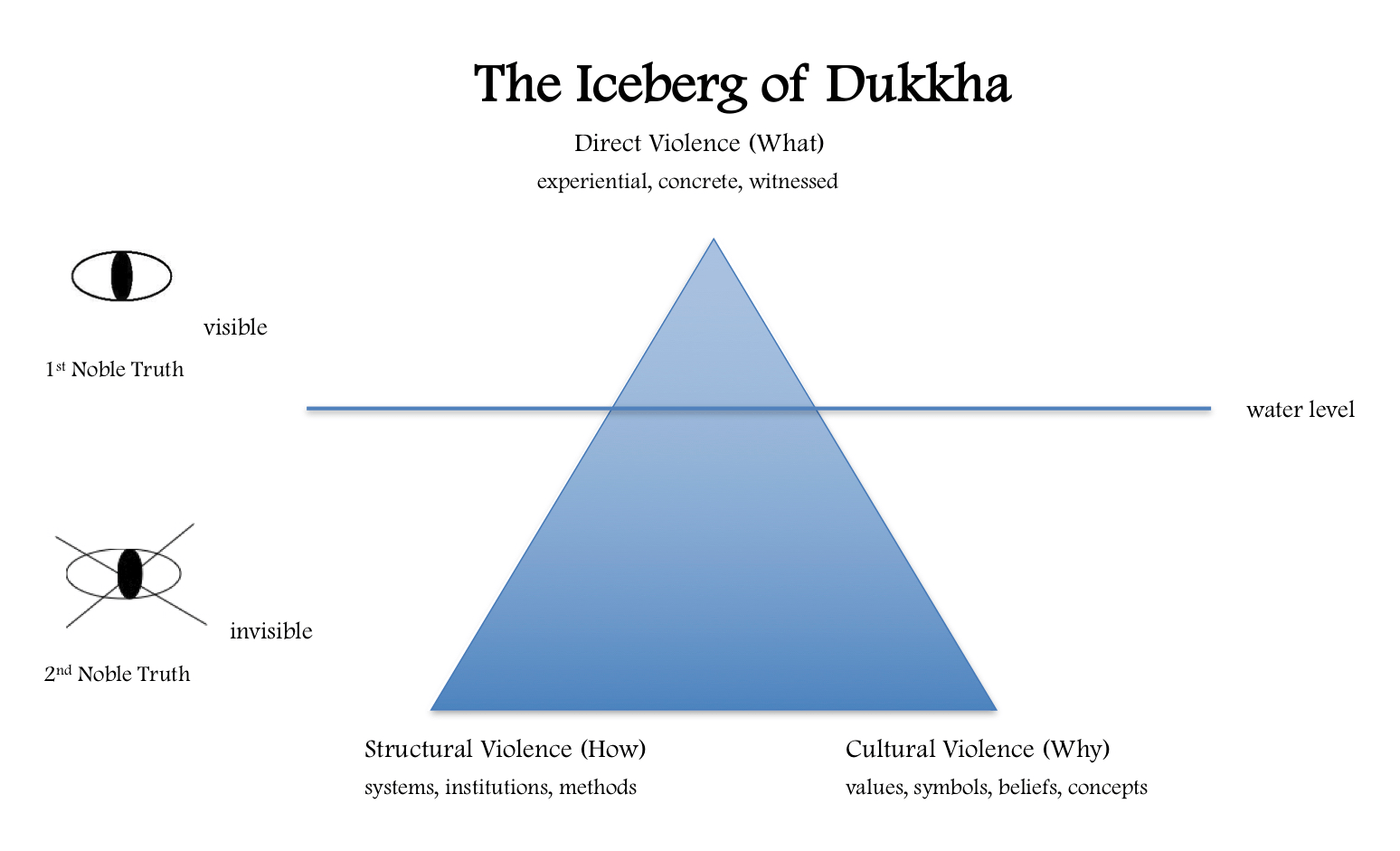 In this model, direct violence is the 1st Noble Truth – the actual experience of harming seen in various social problems like poverty and war. The other two is the 2nd Noble Truth. Structural violence is the systems, institutions and structures that lead to direct violence yet also embody a whole process of violence. Cultural violence is the symbols, images and customs (which include religion, ideology, art, and science) that legitimize structural and direct violence. With direct violence as the apex of the iceberg poking out of the water, structural and cultural violence form its base, usually hidden from sight beneath the water. On the individual level to confront the roots of direct violence in their structural and cultural forms also means to confront one’s own unconscious patterns of belief, thought and action in daily life for which dharma practice, especially meditation, is important.
- Experiential
Structural analysis as the practice of the 2nd Noble Truth is a form of interpersonal communication which is the essential step after story telling. Structural analysis provides a deeper examination and critique of the topology and dynamics of power, which have been presented in the first stage of story telling. It is here that analytical tools can be of great service. To begin with structural analysis before a meaningful social and historical context has been set in story telling risks the danger of becoming merely a discussion of ideas. Further, it may from the beginning marginalize individuals not adept at analytical thinking by denying them the power of their voice and perspective, which is provided through story telling. In addition, structural analysis without a socio-historical context can become not a further examination of the topology and dynamics of power but rather the cloaking of such topology and dynamics through abstract and analytical rationalizing. If the conditions for trust and collectively are not established in the first act of story telling, then structural analysis will not be embedded in an ethical praxis of interpersonal communication.
However, when structural analysis is embedded in such an ethical praxis, it sharpens the critical nature of the dialogue. Story telling can serve as a therapeutic device in breaking the silence on suffering and injustice. The experience of not only sharing but meeting others who have the same kind of dukkha can have a huge emotional effect on releasing from the prison of the individual dukkha-laden self. When we experience others as having the same dukkha, we can see that this dukkha is not just “my” dukkha, but it is a collective dukkha shared by others. The experience can offer a taste of the insight into not-self – the suffering is neither yours, nor mine, but part of us all. Compassion can flow naturally from this insight, especially because when we hear of another’s suffering that matches our own, we can feel and empathize deeply, knowing just how that person feels.
Structural analysis goes another step further in this process as a curative device in enabling victims of such injustice to attain liberative insight into the structural causes of their suffering. Here again, Ouyporn Khuankaew IWP group has found that:
Particularly for women, a structural analysis helps to explain that the suffering women face is not a product of individual karma, action, or misfortune. Recognizing suffering as a result of societal structures empowers women to see the possibility to end it because it is not their fault. They are able to move beyond blaming themselves to identifying violence, understanding root causes, looking for solutions, then working for change. (IWP, 2003)
Not only is the dukkha neither yours, nor mine, but it is also not ours. It is not due to the failings of our character or our race or our gender, etc., but due to unskillful causes and conditions. In this way, we not only find succor in shared dukkha but also begin to free ourselves from the types of personalistic explanations of our dukkha which have been used to keep us imprisoned in self-loathing, fear and passivity. The power of this liberative insight helps to embolden all participants to engage in action to end complicity with the structures of coercive power.
However, this liberation does not mean that we throw off our dukkha at the expense of creating new dukkha for others or for creating revenge. Rather a Buddhist structural analysis enables us to see dukkha in a balanced way. We see actors – persons responsible for causing harm – but we do not demonize them or ourselves. Rather, we try to penetrate the reasons for the cycle of ignorance which keeps us all in dukkha. In this way, a structural analysis – well-embedded in the experience and practice of dukkha – also helps to transform conventional understandings of Buddhist teachings into more dynamic and action oriented practices.
The 3rd Noble Truth
- Conceptual
As is typical of many of the historical Buddha’s teachings, nirvana, as the highest goal of the path, is spoken of in negative terms. The 3rd Noble Truth is the ending of dukkha, and the term nirvana literally means “blown out”, “extinguished”, or “completely cooled”. It is a curious aspect about Buddhist history that although numerous people are said to have gained nirvana during the Buddha’s lifetime, nuns and laypeople included, nirvana increasingly came to be seen as unrealizable in this lifetime. The development of the Mahayana emphasized, especially for laypeople, the importance of the basic realization of faith and “stream entry”, which would eventually lead to nirvana. The extreme form of this is the Pure Land tradition, which sees nirvana as so distant and impossible that is no longer a goal, replaced by rebirth in the Pure Land from which one can gain enlightenment. In the Theravada tradition, the dominance of settled monasticism has on the one hand generally marginalized the forest monastic tradition which focused intently on gaining nirvana in this life. On the other hand, it devalued lay practice (not to mention ending the nuns order) so much that it has largely become one of making donations to the monastic institution in order to gain favorable rebirth from which nirvana can be attained in some distant, future life.
This state of affairs makes Buddhism resemble the very Brahmanism which the Buddha recounted on countless occasions. Whether it be Theravada Buddhists in Thailand or Mahayana Buddhists in Japan, the goal of a majority of Buddhists today in the world seems to be about securing a better afterlife/rebirth though “ritual action” (the Brahmanistic meaning of karma) done by an institutionalized priesthood. As we noted in the 2nd Noble Truth, a static and ontologized understanding of Buddhist causality and dependent origination (paticca samuppada) tends to shift the cause of dukkha and the flow of samsara into multiple lifetimes. When this occurs, untangling the karmic knots of dukkha, and in turn realizing nirvana, becomes a vast metaphysical project beyond the capacity of just about anyone. On a social level, such a metaphysics tends to support social passivity and quietism. If one cannot hope to make much real change to one’s spiritual status now in this life, then in turn why should one think that one could take on and change any kind of social injustice being experienced? In the end, it’s best to pray for a better rebirth and endure one’s karma (i.e. fate) with equanimity (upekkha) – a practice that is actively taught in the Buddhist world today.[2]
However, when we re-infuse the Dharma with its proper sense of dynamism, we can see that the causes and conditions of our dukkha manifest here in this life and in this moment. Consequently, karma is not our fate as drawn out over three times phases, nor any ritual action that we hope can break the spell of our dukkha. Rather, karma is the ethical action we can undertake now to begin to realize the end of dukkha not just for ourselves, but indivisibly with the others we share this life. This is why we call it ethical action, because when we undertake an action, even solitary meditation, with an understanding of our interdependence with other beings and with the intention (cetana) to relieve suffering, it has ramifications not just for ourselves but for others. In this way, nirvana re-emerges on our horizon and we see that each step in the path is an indivisible part of the fullest realization.
In this sense, the great Thai monk Buddhadasa Bhikkhu created an understanding he called “little nirvana”. (Buddhadasa, 1988) This means that at any moment when the mind/heart is free of craving and clinging and is clear and at peace, this is in fact nirvana. It may not be the fully formed and stabilized nirvana of the Buddha, but it is a moment of liberation from the often ever-present experience of dukkha. In this way, nirvana becomes something to realize right here and now in daily life, gradually building up and stringing together these moments of little nirvana into a deeper and fuller expression. In the same way, positive, non-violent social change can begin now in any simple act of non-harming and good will. This can then form the basis of relationships and communities devoted non-harmful living and to confronting and changing various types of harmful socials structures and culture.
- Analytical
On the analytical level of the 2nd Noble Truth, we engaged in a structural analysis of the structural and cultural roots of harming and dukkha. Here in the 3rd Noble Truth, we can use the same framework of the iceberg to engage in a positive re-envisioning of our problem in particular and of our community or society in general.
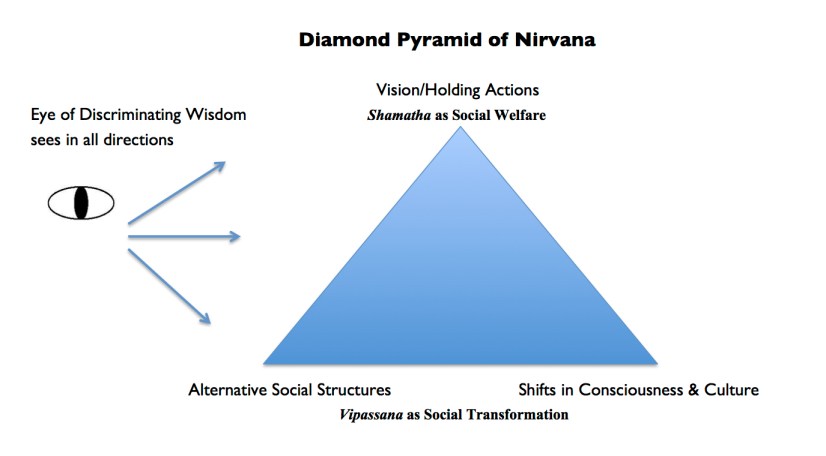
Here in the 3rd Noble Truth, we will engage in an envisioning process than a strategizing or plotting process as with the 4th Noble Truth. In this way, the 3rd Noble Truth can be expressed in the question: “What is the vision of a life and society which is liberated?” or alternatively, “What does it feel like to live in a world where direct, structural and cultural forms of violence and injustice do no exist?”
Now these are somewhat utopian questions since it is unlikely we will solve all the historically concocted problems that exist today within our own short lifetime. However, this envisioning process is a very important one. Envisioning is a creative process which involves prioritizing values and plotting directions for our work and life. In this way, it tempers and balances the activism of the 4th Noble Truth, providing a type of wisdom element to the ethical and compassionate action of the 4th Noble Truth.
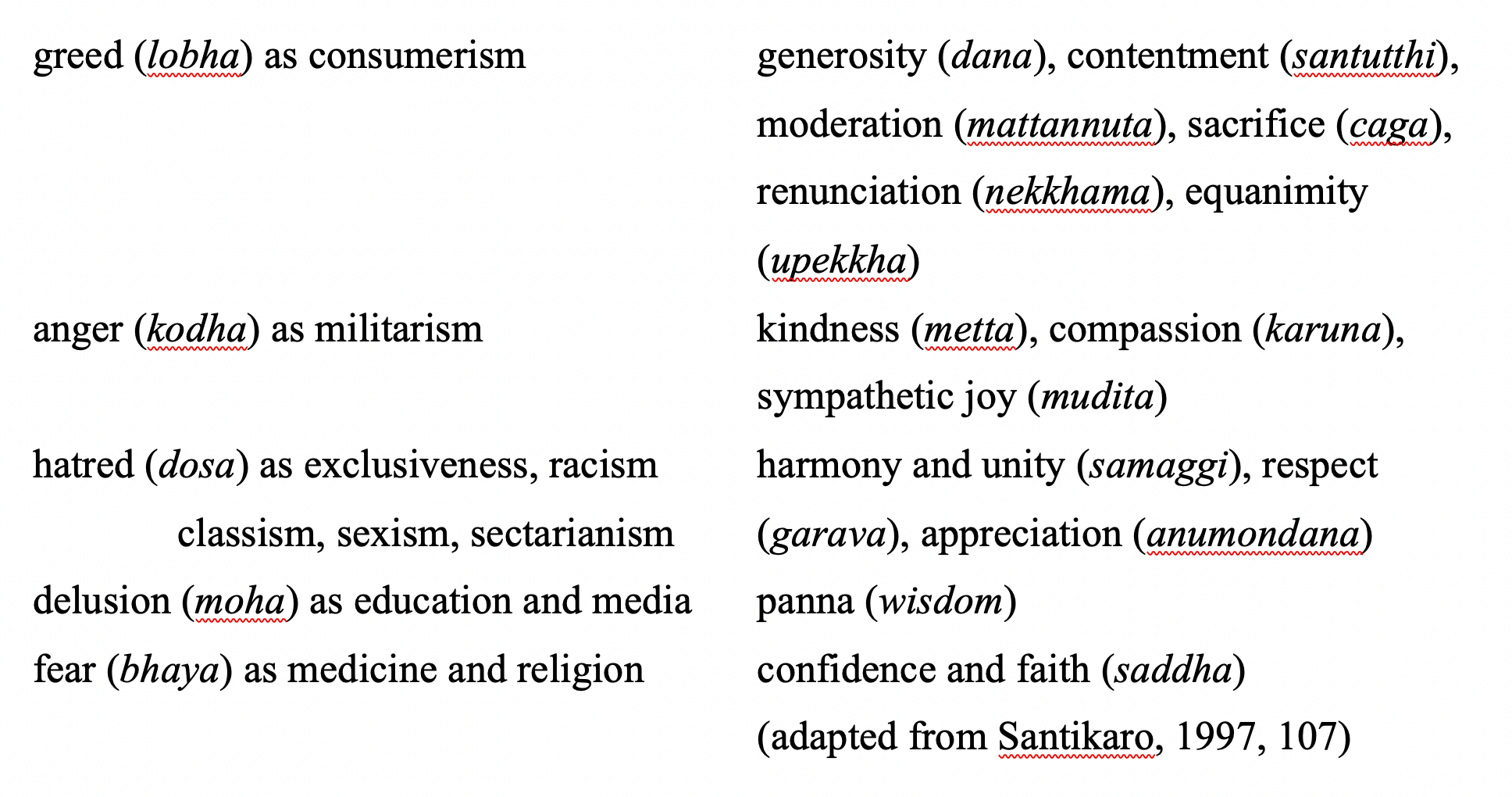
In Buddhism, we learn about all sorts of negative mental states which not only concoct individual dukkha but can also be the foundation for creating forms of structural and cultural violence. At the same time, Buddhism provides an equal amount of positive and skillful mental states and emotions which act as refuges from the negative ones, and as such can serve as antidotes to working with social dukkha. Below, we have listed a few:
- Experiential
If the practice of the 1st Noble Truth begins by grounding oneself deeply in the present experience of dukkha, then the practice of the 3rd Noble Truth begins by grounding oneself in the present experience of nirvana. As we noted with Buddhadasa Bhikkhu’s understanding of “little nirvana”, this experience is accessible through numerous basic Buddhist practices which engender positive mental states, such as joy (pamojja), rapture (piti), tranquility (passaddhi), happiness (sukha), and concentration (samadhi).
As far as the transformative community and society, we saw in the 1st Noble Truth how story telling done within an ethical community can also create significant positive mental states, such a relief and compassion when collective dukkha is first seen. In the 2nd Noble Truth, the experience of then doing structural analysis after story telling can provide excitement, energy and insight into not-self (anatta) when the cause of dukkha is seen not to be inherently located not within oneself but also located in various external causes and conditions. While this insight acknowledges responsibility in both oneself and others, it demonizes neither group and provides the standpoint for compassionate and non-harmful responses.
In this way, the 1st Noble Truth of sharing suffering is not enough. Although it may be therapeutic to experience shared dukkha with others, the group still remains in dukkha and may form a “co-dependent” relationship where identity (atta) and solidarity is grounded in the dukkha itself. Further, the 2nd Noble Truth may also not be enough. There can still be the tendency – once causes and conditions have been seen – to externalize blame and responsibility in an abstraction (the state, the corporation, the church) or in an antithetical group (foreigners, the poor, unbelievers). For the movement from the 2nd to the 3rd Noble Truths to occur, the insight into not-self must accompany the structural insight into causes and conditions. This is where dharma practice critically grounds the structural analysis work and helps to transform it from an intellectual activity that can be prone to unacknowledged and unskillful mental states into an experiential activity which leads to the positive mental states outlined above. An authentic group process of story telling and structural analysis grounded in dharma practice will temper natural responses of anger, resentment, blame, etc, and lead the group into seeing the whole concocted mess of violence and injustice as a shared dukkha from which all should be liberated through non-violent and compassionate means.
Again, Khuankaew in her experience with IWP that it is important to find male allies willing to take part in such group practice. In this way, the issue does not remain a “woman’s problem” but is seen in larger terms as also a man’s problem and more fundamentally a human problem (Khuankaew, 2003, p. 4). IWP has attempted to confront the combative nature of gender dialogue by engaging in these issues “nonviolently with assertiveness” (IWP, 2003). They see their work as not antagonistic in the sense that women must take the power of men. Rather, they seek to define a unique style of feminine leadership which involves “power sharing, seeing community power as collective. This involves trust building, and collective leadership and decision making” (IWP, 2003).
The 4th Noble Truth
- Conventional
In the 3rd Noble Truth, we noted how the conventional understanding of nirvana has made it so remote and unattainable in this lifetime that Buddhist practice for lay people effectively precludes any attempt at working towards it. Those who understand the path towards nirvana to be an exclusively monastic one tend to also have a limited sense of the 4th Noble Truth, which is constituted by the Noble Eightfold Path. This path and the monastic way of life are commonly abbreviated as the Threefold Practice (tri-sikkha) of precepts-meditation-wisdom (sila-samadhi-panna). Monastics take on the more than two hundred training precepts as a basis for their life. Upon this basis, they engage in mental cultivation, specifically meditation, and in turn develop insight and wisdom into reality and liberation.
While it is true that devoted lay Buddhists may enter a monastery for a short period to do this practice themselves, and exceptional ones undertake such practices in their busy daily lives, for the most part they are left out of this process. While lay Buddhists are encouraged to take on the five basic precepts (pancasila) of non-harming, the core of lay practice in most Buddhists societies is the practice of generosity (dana). While a deep understanding of this practice can lead to the highest fruits of practice, it has unfortunately taken on a retarded, Brahmanistic quality. (Santikaro&Phaisan, 2004) Generosity is often confined to making material donations to the monastic sangha and to the temple, usually with the core intent of gaining merit for a good rebirth in the next life. In this way, lay practice has become not about the liberation from samsara but the investment in samsara as lay followers make material and spiritual investment in gaining rebirth. (Zin, 2004) Here again we can seen how karma has lost the Buddha’s innovative ethical sense and has reverted into a Brahmanistic one of ritual action aimed at attaining metaphysical dreams (of rebirth).
Curiously, if one looks at the Noble Eightfold Path, the first set of practices do not concern the precepts (sila), but rather wisdom (panna). In this way, wisdom is not the somewhat static sense of a final set of insights at the end of long and arduous monastic training, but rather it is a dynamic way of seeing and being in the world from which springs ethical action (sila), not just precepts, and insightful awareness (samadhi), not just meditation.
The first group of wisdom practices are Right Understanding or View (samma ditthi) and Right Thought or Intention (samma sankappa). Traditionally, Right Understanding is the right understanding of the Four Noble Truths. However, as we noted in the 1st Noble Truth, this samma ditthi is about learning how to understand and not exactly what we understand. Samma ditthi is seeing that truth is dynamic and that “All systems of thought are guiding means; they are not absolute truth.” In turn, Right Thought moves the mind/heart towards ethical action by establishing the fundamental intention of “harmlessness and freedom from ill will.”
It is from this basis – which is more than just conceptual or analytical – that the three ethical action practices (sila) emerge, specifically, Right Speech (samma vaca), Right Action (samma kammanta), and Right Livelihood (samma ajiva). As with Right Intention, Right Action reaffirms the core Buddhist value and practice of non-harming (ahimsa). Remarkably, Right Livelihood immediately follows this as a teaching which extends to the social level. Thus non-harming has a distinct social meaning. It is not enough to be kind to just one’s family and colleagues, but one’s work should also not create harmful results for anyone anywhere.
From these ethical actions follow the final three practices of insightful awareness or mental cultivation (samadhi), specifically Right Effort (samma vayama), Right Mindfulness (samma sati), and Right Concentration (samma samadhi). Stereotypically, Buddhism has been seen to focus on individual practice and liberation first – through rigorous training and meditation one can attain liberation and then benefit the world. However, here we can see in the very Noble Eightfold Path, that meditation and mental cultivation come after ethical action. This does not mean that individual spiritual practice is not as important, but rather this emphasizes the need for balance in practice. The personal and social are intimately interconnected in Buddhist practice. Buddhism is not about monastics cut off from the world practicing meditative austerities for their own benefit, although this has its place. Buddhism is a dynamic practice of developing oneself (samadhi) as one engages in ethical community with others (sila) in a process of an ever unfolding practice of insight and liberation (panna).
- Analytical
In the 3rd Noble Truth, we engaged in an envisioning process about a nirvanic society. In this way, we began the first practices of the Noble Eightfold Path as envisioning is a kind of Right Understanding and Right Intention towards the ethical action of creating a healthy society. Here, we can rephrase the 4th Noble Truth in social analysis terms as, “What is the way of a life and society which is liberated?” or alternatively, “How do we create a world where direct, structural and cultural forms of violence and injustice do no exist?”.
Today we are seeing more and more socially engaged Buddhists active in developing such a dharmic social vision. Santikaro, a student of Buddhadasa Bhikkhu, has developed a specifically social interpretation of the Noble Eightfold Path, much in the way that Thich Nhat Hanh socialized the five precepts into the 13 Tiep Hien Precepts. In short, he explains them as:
- Right Understanding as Right Religion and Right Education
- Right Thought as Right Leadership and Right Organization & Government
- Right Speech as Right Communication
- Right Action as Right Culture and Right Family & Sexuality
- Right Livelihood as Right Economy and Right Ecology
- Right Effort as Right Play
- Right Mindfulness as Right Monitoring
- Right Concentration as Right Sangha & Solidarity
(Santikaro, 1997, 146)
A.T. Ariyaratne is probably the foremost example of someone who has done a systematic analysis of society basis on Buddhist principles (1st & 2nd Noble Truths) and then developed specific Buddhist values, practices, and institutions for addressing social problems (3rd and 4th Noble Truths). In fact, he has very explicitly used the Four Noble Truths to analyze the problems of rural villages in Sri Lanka and devise solutions for solving them (Macy, 1985, 34). Both he and socially engaged Buddhist monks and laypeople in Thailand have articulated an alternative form of social development that we might call “Dharmic Development”.[3] In Dharmic Development, material development is not shunned, but rather it is seen that spiritual, ethical and cultural development forms the fundamental basis of social, economic and political development – not vice versa – and that these various sectors need to come together in one holistic development practice.(Macy, 1985, 34)
- Experiential
There are numerous different methods and ways that have been and are still being developed to form transformative, socially engaged Buddhist communities. The key word here, of course, is community. Throughout this whole paper, we have emphasized the fundamental difference between progressive understandings of Buddhism, which are dynamic and infused with ethical action, and regressive ones, which posit static ontological truths and revert into ritual action and social apathy. Santikaro’s Noble Twelvefold Social Path conspicuously culminates in Right Sangha & Solidarity.
In the experiential model this paper has outlined, we begin our community through finding others with which to share our suffering (1st NT). Our community then can develop further when we join with those others to understand the common roots and causes of our suffering (2nd NT). From this experience, we find some relief and hope from realizing the creation of a community bound together through our common humanity (3rd NT). However, we take these new positive experiences forward in developing a positive and non-harming vision of solving our problems – not through demonizing and destroying those we see as the cause of our suffering, but rather by developing positive and non-harmful social and cultural structures which help realize a society that benefits all (4th NT).
On the other hand, if we have an intact community, we use story telling as a means for sharing suffering and promoting deep listing and right speech (1st NT). This sharing provides the contextualized history and exposes the topography of power from which we can then engage in a meaningful social analysis of cultural and structural problems (2nd NT). From this social analysis, we can then begin to engage in a holistic ethical practice (sila), which includes individual cultivation (samadhi), that envisions and develops liberative cultural and social structures within our group and/or with other groups (panna).
The Four Noble Truths of Socially Engaged Buddhism
- Story Telling using deep listening and right speech
- Social Analysis (structural and cultural) using dependent origination
-alternative critical Buddhist analysis: How do Buddhist teachings and practices (cultural) and institutions (structural) support dukkha?
- Envisioning and cultivating positive mental states and culture
-alternative critical Buddhist development: How can Buddhist teachings and practices (cultural) and institutions (structural) support nirvana?
- Ethical Praxis as sangha building using the Noble Eightfold and Twelvefold Social Paths
Bibliography:
Bodiford, W. (Spring, 1996) “Zen and the Art of Religious Prejudice: Efforts to Reform a Tradition of Social Discrimination”. Japanese Journal of Religious Studies 23/1-2, Nagoya, Japan. pp. 1-27.
Buddhadasa. (1988). Nibbana for Everyone. [Pamphlet] http://www.suanmokkh.org/archive/nibbevry.htm
Khuankaew, O. (2003, February). Buddhism and Domestic Violence. Paper presented at the 4th international Think Sangha Meeting, Chiang Mai, Thailand. http://www.bpf.org/tsangha/tsm03report/Karma%20Book/khuankaew.html
International Women’s Partnership (IWP). (2003). Empowering Asian grassroots activists to build just and peaceful communities [Brochure].
Macy, J. (1985). Dharma and Development: Religion as a Resource in the Sarvodaya Self-help Movement. Hartford, CT: Kumarian Press.
Nhat Hanh, T. (1987). Interbeing: Commentaries on the Tiep Hien Precepts. Berkeley, CA: Parallax Press.
Santikaro. (1997). “The Four Noble Truths of Dhammic Socialism”. in Watts, J., Senauke, A. & Santikaro (eds.). Entering the Realm of Reality: Towards Dhammic Societies. Bangkok: Suksit Siam. pp.89-162.
Santikaro & Phaisan. (2014). “Goodness and Generosity Perverted: The Karma of Capitalist Buddhism in Thailand. in Watts, Jonathan, Ed. Rethinking Karma: The Dharma of Social Justice. Bangkok: International Network of Engaged Buddhists. pp. 133-156
Zin, M. (2014). “Burmese Buddhism’s Impact on Social Change: The Fatalism of Samsara and Monastic Resistance”. in Watts, Jonathan, Ed. Rethinking Karma: The Dharma of Social Justice. Bangkok: International Network of Engaged Buddhists. pp. 157-176.
[1] See the Madhupindinka Sutta, Majjhima Nikaya, i.108-114.
[2] Especially to women in Southeast Asia (Khuankaew, 2003) and other countries like Japan (Bodiford, 1996; as well as social outcastes (burakumin) in Japan (Bodiford, 1996); and the general populace in militarily dominated Burma (Zin, 2004).
[3] The renowned Thai scholar monk, P.A. Payutto, has distinguished between modern material development (Thai: pattana) driven by craving (tanha) and Buddhist cultivation and internal development (bhavana) driven by “wise want” (chanda). The Japanese have developed a clever distinction on this understanding within their own language with material development (kaihatsu) and “dharmic development” (kaihotsu). Hatsu/hotsu are the same Chinese character, but hotsu is an older pronunciation with Buddhist nuances regarding bhavana and the opening of the spiritual eye.
 Contemporary Buddhism in Japan & Asia