
see complete paper at this link:
The Four Noble Truths as Experiential Social Praxis
The 4 Noble Truths (四聖諦-ししょうたい) are the most basic expression of Shakyamuni’s (563-483 B.C.), the historical Buddha, teachings:
1) Existence is dukkha (suffering, dissatisfaction, dis-ease)
我々の存在は苦し みしかし「苦」の深い意味は不満足と不安心である。
2) The cause 集じゅう of suffering/dukkha occurs through an interdependent causal process which begins with ignorance and develops into greed, anger, and delusion.
色々な原因と結果 の積みかさね(=縁起)は苦しみを生み出す。苦しみは知らないこと(無明むみょう)と三毒(貪・むさぼり、瞋・いかり、痴・おろかさ)から始まる。
3) Nirvana (涅槃/滅度) is the ending of the causes and conditions of dukkha.
「苦」の色々な原因と結果の積みかさねがなくなるのは涅槃か滅度である。
4) There is a way to realize this ending of dukkha, specifically the Buddha’s Eightfold Path.
「苦」がなくなる方法か道がある。仏教ではこの 道がお釈迦様の八正道
3 Ways of Understanding the Four Noble Truths:
1) a statement of truth – 概説
2) a way of analyzing a situation – both on the individual and social levels
状況分析の方法「個人レベルと社会レベルも」(理論的)
3) an injunction to experience – 経験の必要 性 (実践的)
They are best understood not as beliefs but as recommendations for how to investigate and experience our lives. In a common daily chant in the southern orthodox school of Buddhism (Theravada/上座部仏教), the Buddha’s teachings are summarized as:
To be realized by oneself (sanditthiko)
Timeless in practice and fruition (akaliko)
Inviting others to come and see (ehipassiko)
Leading ever deeper into the heart (opanayiko)
Experienced personally by the wise (paccatam veditabbo vinnuhi)
The 1st Noble Truth
1) Existence is dukkha (suffering, dissatisfaction, dis-ease)
我々の存在は苦しみしかし「苦」の深い意味は不満足と不安心である。
2) What is the problem? 問題は何ですか
How is it directly experienced (direct violence/ direct dukkha), both on the individual and social levels?
個人レベルと社会レベルでも「苦」をどのように直接経験するか。
3) How do we experience the problem? 問題はどうふに経験しますか
We must not run away from our suffering and our problems. This only leads to temporary solutions which may eventually become big problems (e.g. alcoholism).
「苦」から逃げるべきでない。 一時的解決は最後には大きな問題になる(お酒の 中毒)
We need to share this suffering and to tell our stories with friends, family or some kind of safe community (sangha). This is the real meaning of sangha in Buddhism, not just the community of monks. This sharing and story telling is essential in any group setting for creating an atmosphere of right speech and deep listening. It helps to empower all members to participate actively and equally before the more intellectual work of social analysis is done.
友達、家族、組織と一緒に自分の「苦」をシェアする必要がある。その友達 と家族と組織=本物の仏教の「衆しゅ」/sangha、僧侶団体だけではない。グループワークにおいて、お互いがお互いの言葉 に耳を傾け、話したいことをきちんと話すことができる雰囲気を作るためには、自分の気持ちを分かち合い経験を語りあうことが非常に大切です。それによっ て、参加している人達はエンパワーされ(力をつけることができ)、平等にグループワークに参加することができるようになります。
The 2nd Noble Truth
1) The cause 集じょうof suffering/dukkha occurs through an interdependent causal process which begins with ignorance and desire/craving/attachment. 色々な原因と結果の積みかさね(=縁起)は苦しみを生み出す。苦し みは知らないこと(無明むみょう)と欲しいこと (取しゅ)から始まる。
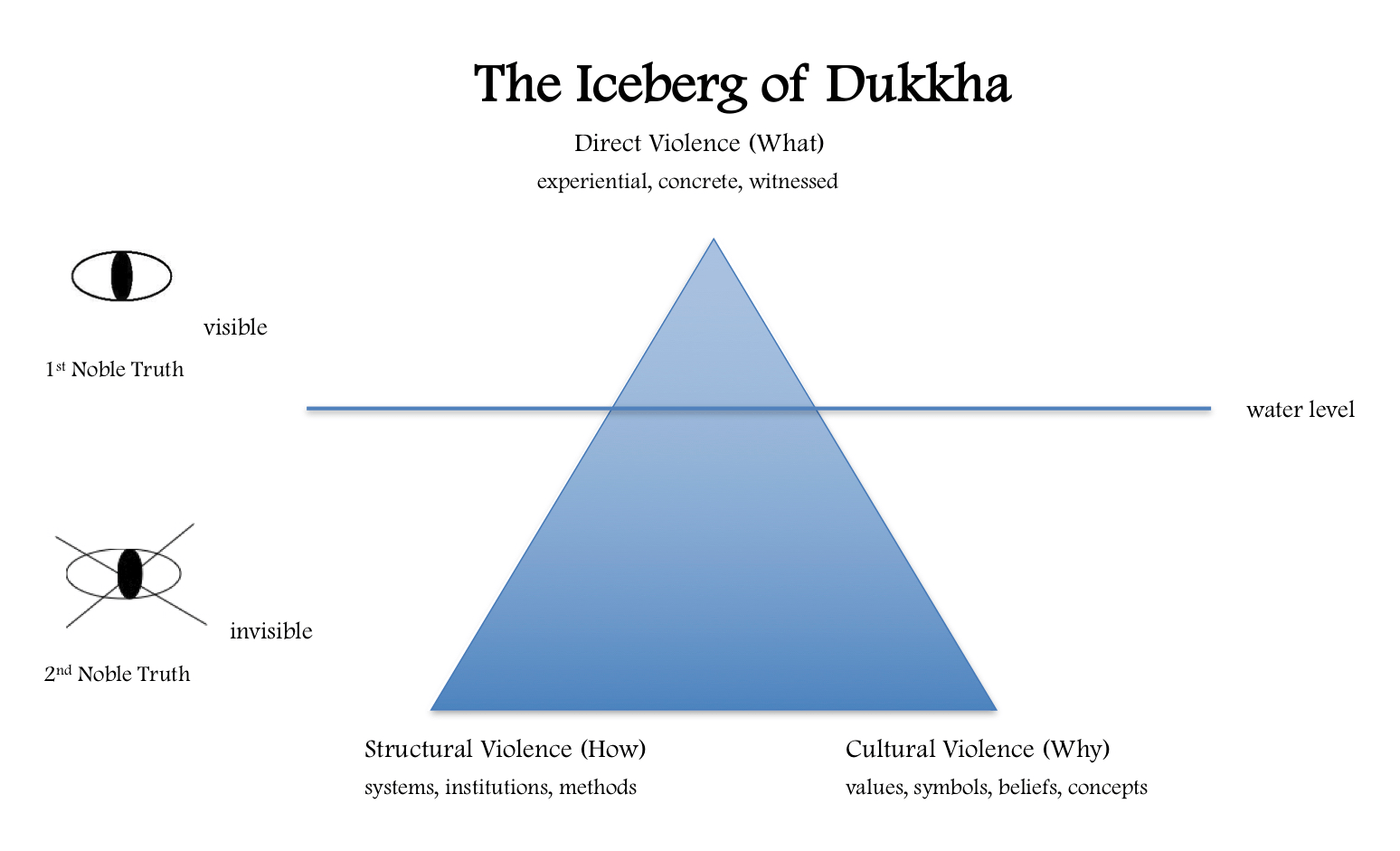
2) What are the structural and cultural sources of violence/dukkha?「苦」の構造的と文化的の原因は何ですか
Structural Violence = systems, institutions, and methods which lead to harm to our basic human needs of a) survival, b) well-being, c) identity, d) freedom, and e) nature
構造的= 機構と制度と組織と方法は人間にとって基本的に必要な物
Cultural Violence = the values, symbols, ideas, and beliefs (found in religion and ideology, language and art, and science) used to justify, or legitimize direct or structural violence.
文化的= 価値と象徴と思想と信念「宗教とイデオロギと言 葉と芸術と科学の中に」は直接問題と構造的原因を弁明する。
To confront the roots of direct violence in their structural and cultural forms means also to confront one’s own unconscious patterns of belief, thought and action in our daily lives.
毎日の生活の信念と思想と行動の無意識パーターンに対さなければならい。
for a more detailed explanation of these concepts, see the articles by Johan Galtung who developed them. Article 1 & Article 2
3) How do we discover the causes, conditions and processes that create the problem/dukkha?
「苦」の色々な原因と結果の積みかさねはどうやって見つかる?
When we experience our own suffering, it is difficult to bear and we need to share it with others. Some of us don’t have others, which is why we need a group or community (sangha). By sharing our own suffering with others, we see that: 1. We are not alone and that others suffer similar problems, 2. our suffering is not completely our own fault. Seeing that our and others’ suffering is due to causes and conditions which involve others and society, and that these connections are shared dukkha, leads us to see not-self (anatman). This is not MY suffering alone. The group or community (sangha) also offers a place to explore more deeply the causes and conditions of personal andsocial suffering and examine structural and cultural causes.
「衆」/sanghaでシェアすると:1. 私は一人ではない。他の人は「苦」がある。2. 私の「苦」は全部私のせいじゃな いSangha (衆)で個人的と社会的「苦」の色々な原因と結果の積みかさね をよく見てみる。他の人も自分と同じような「苦」を抱えているとことを知 ると、「縁起」(色々な原因と結果の積みかさね)が分かる。縁起が分かると「苦」を分かち合うこによって、「苦」は私の個人だけのものではない=仏教の中心教えの「無我」
The 3rd Noble Truth
1) Nirvana (涅槃/滅度) is the ending of the causes and conditions of dukkha.
「苦」の色々な原因と結果の積みかさねがなくなるのは涅槃か滅度である。
2) What is the vision? ビジョンは何ですか?
What does it feel like to live in a peaceful, non-violent society? How is it experienced?
平和で非暴力で無害な社会に住むのはどんな感じでしょうか。どのような経験ですか。
3) How do we perceive things when suffering ends?
「苦」のなくなる 時に 何の認識になりますか?
When we share our own dukkha with others in a group or community, we see that we are not alone, that others suffer, and that we are all connected in suffering together. This leads into compassion, “to feel with”. The taste of connection & compassion, instead of dukkha, is the first taste of nirvana.
Sangha (衆)でシェアすると、「苦」を抱えているのは一人ではないことがわかり、他の 人とつながっていることになる=縁。この縁の経験をすると慈悲の気持ちを抱けます。「慈悲」=“to feel with” 一緒に感じる、縁起と無我と慈悲の気持ちは涅槃の最初の味。
The 4th Noble Truth
1) There is a way to realize this ending of dukkha, specifically the Buddha’s Eightfold Path.
「苦」がなくなる方法か道がある。仏教ではこの道がお釈迦様の八正道

2) What is the way to realize our vision? ビジョンはどうやって達成するか
A peaceful society is realized through creating non-violent social structures and a non-violent culture which is ethical, develops the inner and outer, and is just through three modes of action: 平和的社会の達成 方法は無害的と非暴力的構造と文化を造る。この構造と文化は道徳的であり開発的かいほつと公正なである。
Holding Actions: short-term, emergency level actions that get at the symptoms but not the root causes of the problem. To come to the immediate aid of those experiencing the suffering of the 1st Noble Truth. Joanna Macy notes, “Work of this kind buys time. It saves some lives for the sustainable society to come. But it is insufficient to bring that society about.”
Alternative Social Structures: longer-term activities that address the root causes of the problem discovered in the 2nd Noble Truth. Sometimes, through the continual practice of holding actions, alternative structures may be created. However, much of this work involves more strategic, deep thought of how to build alternatives. Joanna Macy notes, “Not waiting for our national or state politicos to catch up with us, we are banding together, taking action in our own communities. Flowing from our creativity and collaboration on behalf of life, these actions may look marginal, but they hold the seeds for the future.”
Shifts in Consciousness & Culture: in order for our long-term strategies to become effective, we must begin to re-educate people about the reasons for suffering found in the 2nd Noble Truth as well as build new values of caring and concern (as seen in the variety of Buddhist ethical practices). Joanna Macy notes, “Structural alternatives cannot take root and survive without deeply ingrained values to sustain them. They require a profound shift in our perception of reality, both as cognitive revolution and spiritual awakening.”
for a more detailed description of these three modes of action (holding actions, alternative social structures, and shifts in consciousness & culture), see the work of Joanna Macy
3) How do we experience this vision? ビジョンの達成する活動はどうやってけいけんするか?
Within a group or community, we can realize peace and non-violence through:
- ethical treatment [respect and non-harming] of oneself and others (sila)
- the inner development of the heart and mind (samadhi)
- being able to recognize what is helpful to oneself and others, and non-harmful (panna)
* (sila-samadhi-panna are a capsule of the Eightfold Path)
Sangha (衆)で平和と無害を達成する道は:
- 他の人と自分を敬い害を与えない=戒 (道徳生活)
- 自分の心の修養をする= 定 (瞑想と実践)
- 他の人と自分にとって有益なことと無害なことを 認識することできる= 慧
* 戒-定-慧は八正道を意味する
The Four Noble Truths as Personal and Social Transformation
個人と社会開放のように四聖諦
- Story Telling using Deep Listening and Right Speech
傾 聴と正語で苦しみをシェアする
- Social Analysis using Dependent Origination
縁 起の認識で社会分析をする
- Sangha Building using the Noble Eightfold Path
八 正道でSangha (衆)を作る
NOBLE TWELVE FOLD SOCIAL PATH by Santikaro (disciple of Buddhadasa Bhikkhu)
- Right Religion
- Right Education
- Right Leadership
- Right Organization & Government
- Right Communication
- Right Culture
- Right Sexuality & Family
- Right Economics
- Right Ecology
- Right Play
- Right Monitoring
- Right Sangha & Solidarity
 Contemporary Buddhism in Japan & Asia
Leave a comment