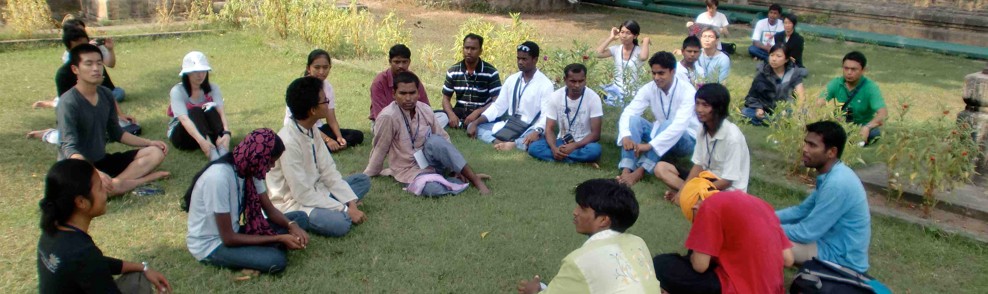
The INEB “Young Bodhisattva” Program, focused on international Buddhist leadership training for spiritual resurgence and social innovation, was back in action in 2011 after a three year hiatus, holding training workshops in late July and late October. This article will look at the most recent and larger one held before the main INEB Conference in Bodhgaya, India-the site of the Buddha’s enlightenment.
After a three-year hiatus in the program, the workshop held over 5 days at the Cambodian vihara in Bodhgaya yielded quite remarkable connections and energy. This could largely be attributed to the maturation of the seeds first planted in 2002 by the founder of the program, former INEB Executive Secretary, Lapapan “Anne” Supamanta. Of the 30 participants coming from 8 countries, almost all came from organizations created as extensions of the program by alumni (Buddhist Youth Empowerment Program-Burma, Socially Engaged Buddhists of Ladakh-India, Dharmajala-Indonesia) or from organizations active in the program since the beginning (Youth Buddhist Society-India, Nagarjuna Training Institute-India, Deer Park Institute-India, Spirit in Education Movement-Thailand). In this way, the workshop did not have a beginner’s level atmosphere as most of the participants had been involved in local training workshops in their own countries and had a familiarity in looking at social issues through a Buddhist perspective. Very quickly the group developed an intimate style of communication that grew more deeply during the workshop and further on through the INEB Conference.
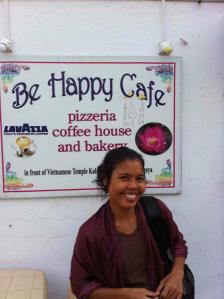
The group was facilitated but certainly not led over the five days by a three person team: Sunisa (“Om”) Jamwiset, an alumnus of the first youth workshop in 2002 and long time member of Wongsanit Ashram in Thailand, Narumon (“Mon”) Paiboonsittikun, an eco-village trainer from the Spirit in Education Movement in Thailand, and Jonathan Watts from the INEB Think Sangha, living now in Japan. Through the whole program, these three facilitators did their best to provide frameworks for the young participants to discover what aspects of Buddha Dharma and what aspects of society are important for them as they endeavor to develop themselves as Dharma practitioners and social activists.
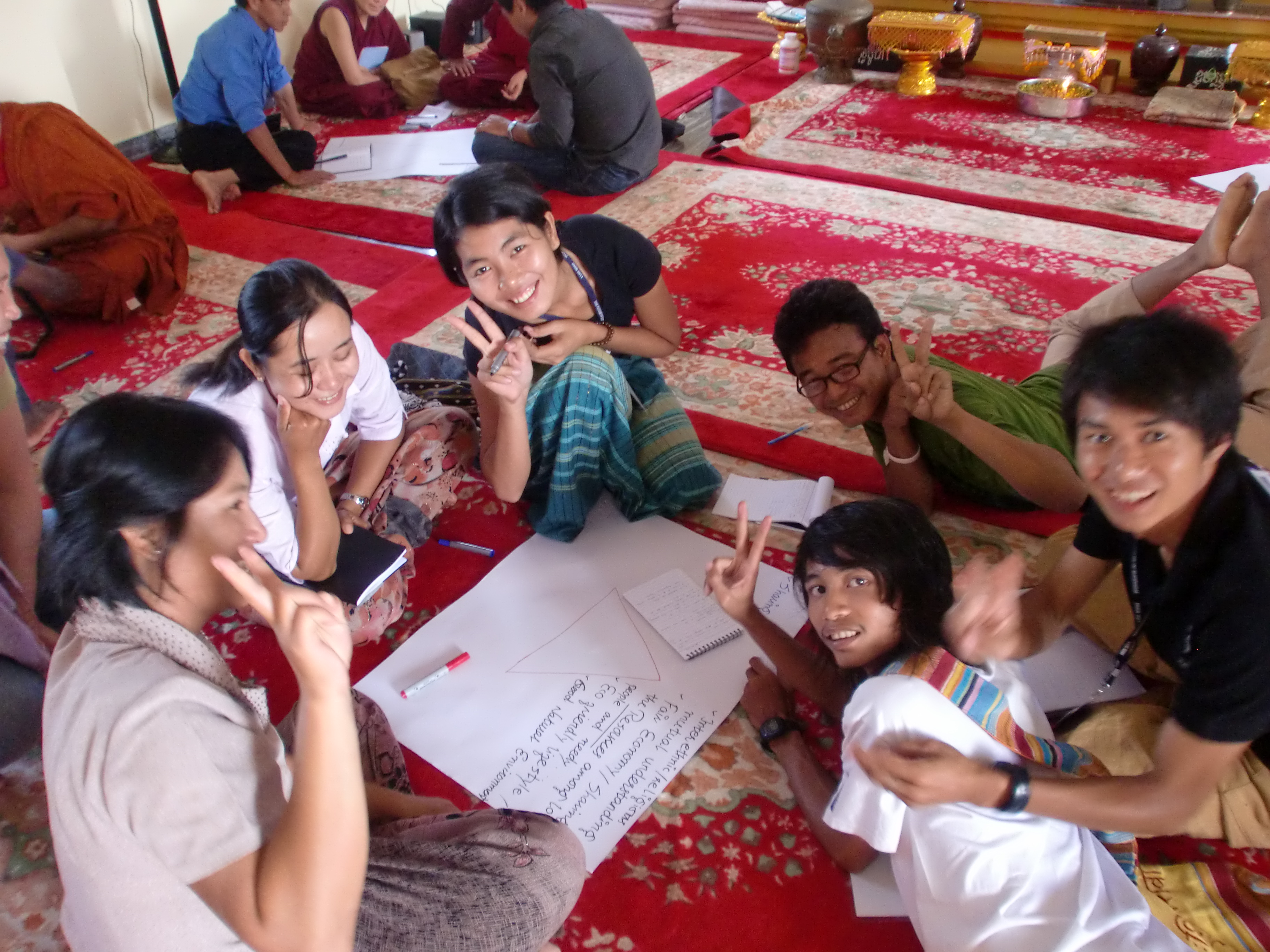
In this way, Om and Mon spent the entire first day of the workshop doing experiential activities for the participants to develop a certain level of intimacy needed for meaningful communication and to help them define the ways that they would communicate over the coming days. The second day was largely facilitated by Jon as the group plunged into using the Four Noble Truths to examine and analyze the issues in their respective communities. This day was devoted just the first two Noble Truths, the direct experience of dukkha and the structural and cultural causes behind it.
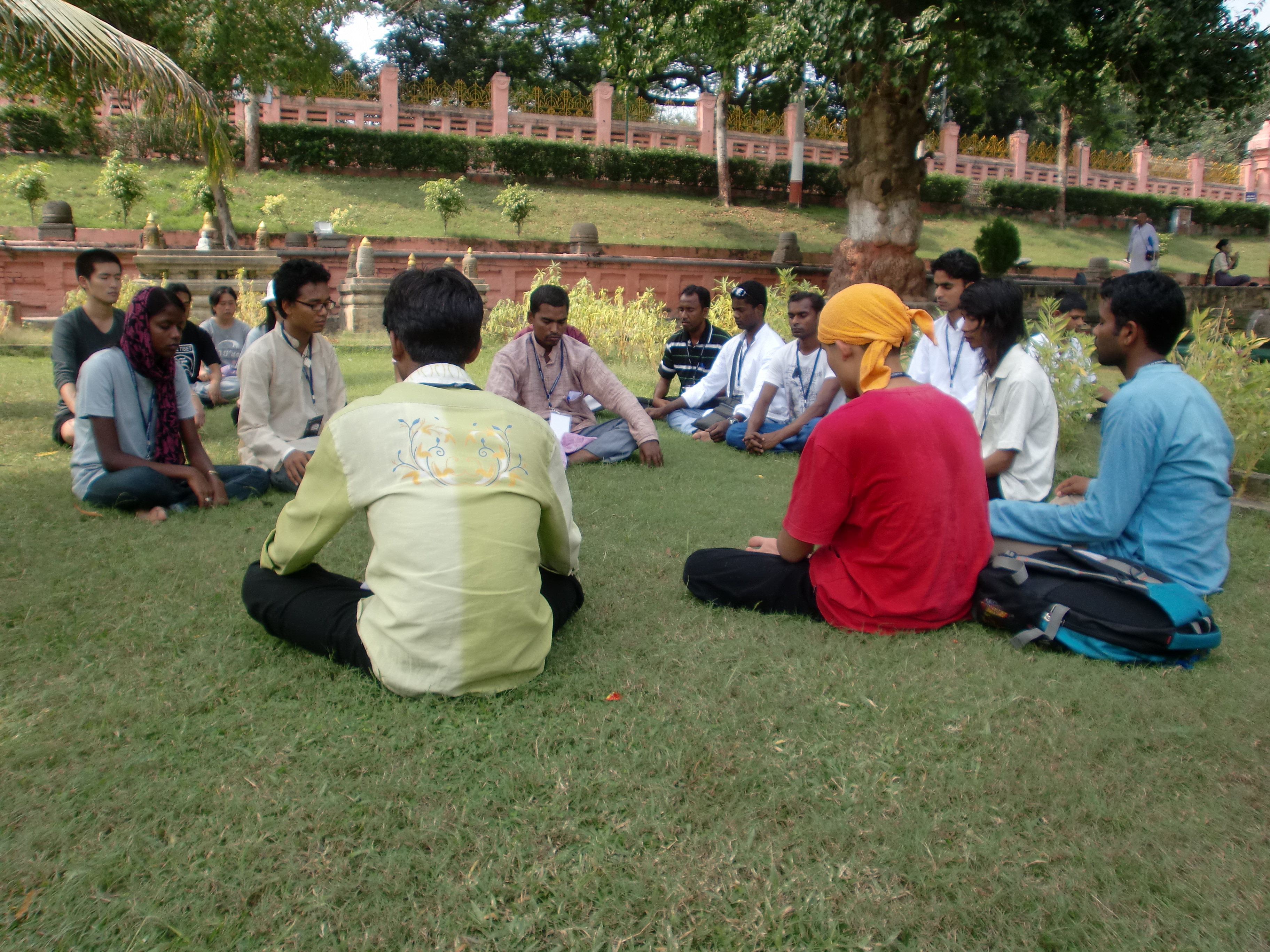
After two days of exhilarating and exhausting interpersonal work within the confines of the Cambodian temple, Om led the group out of the temple on a mindfulness walk through the streets of Bodhgaya to see with the eyes of the Buddha the dukkha of human existence by following his footsteps to the Maha Bodhi temple. Anyone who has travelled in India and especially spent time in Bodhgaya, amidst its wonders and sufferings, naturally develops a much deeper appreciation and understanding of the social impact of the Buddha’s teaching. In the afternoon and evening the participants spent time with the artists at the nearby Thai temple who were part of the first INEB International Buddhist Art Gathering.
With energies recharged, Jon led the group on the fourth day through the third and fourth Noble Truths, a process of envisioning dharmic community in their locales and regions and the structural and cultural foundations of such a community. This work flowed into the last day in which participants looked at action plans for the immediate future and learned from INEB’s present Executive Secretary, Somboon “Moo” Chungprempree, about the overall structure of the INEB Young Bodhisattva program—3 levels of: 1) local training, 2) international and specialized trainings, and 3) support for creative new programs by individual young bodhisattvas. Vidya KV Soon from Malaysia also gave a presentation on INEB’s new Right Livelihood Fund, which is a social investment fund aimed at supporting grassroots Buddhist based social projects.
The INEB Young Bodhisattva program is perhaps the most successful sustained program coming out of the INEB Secretariat itself. Proof of this was clear in the very conference in Bodhgaya this time, which was developed, coordinated, and executed on the ground by Young Bodhisattva alumni and present participants from the three Indian host organizations: Youth Buddhist Society, Nagarjuna Training Institute, Deer Park Institute. In 2002, the need for a new generation of INEB leaders was apparent, and INEB was in a critical state of reformation. Now, a decade later, INEB is thriving, and much of it is due to the energy and leadership coming from the first generation of these Young Bodhisattva alumni who occupy important positions within their own engaged Buddhist organizations and also within INEB’s core leadership structures. The focused enthusiasm of this present group of participants bodes very well for the future of not just INEB but of the meaningful development of engaged Buddhism at the grassroots level across Asia. With a new restructured Young Bodhisattva Program and the development of other INEB programs like the Right Livelihood fund, INEB hopes to be able to more effectively nurture the vision and aims of these young Bodhisattvas.
However, besides the “important work” that lies ahead for these young participants, the greatest impact of this past five day workshop was the incredible bonding that took place amongst the participants outside of the official program; through early morning walks to and meditations sessions at the Bodhi tree, afternoon gatherings at the Be Happy Café (promotion intended!), spontaneous evening gatherings to talk and play music, and unexpected one-on-one interactions from sharing in a trip to the local store or sharing a personal suffering. One participant remarked in the final reflection on the evening of the 5th day that he had never been in a group that developed such intimacy in such a short time. Perhaps it was due to the special though not serene energy of Bodhgaya itself; perhaps it was our common connection in Buddha Dharma acting as a river for us to immerse ourselves in. Whatever the reason was, this particular workshop realized INEB’s highest ideal of developing spiritual friendship, kalyanamitra, which is the bond that empowers us to transforms society as we transform ourselves.
Reported by Jonathan Watts
 Contemporary Buddhism in Japan & Asia