Course Plan
Unit 1: the Social Foundations of Buddhism
April 9
Class 1: Introduction: What Is Religion? & A Brief History of Buddhism
- Introduction to course
- Class discussion: What Is Religion? Is religion about what you believe OR how you live? Is religion about what happens after death/heaven/salvation OR how you find happiness and lead a good life today? What should be done when people do bad things: make a ritual, make them confess, punish them, condemn them to hell, forgive them?
- Presentation: A Brief History of Buddhism
Class 2: Buddhist Sociology: A Community of Liberation, A Culture of Diversity, An Institution of Power
- Group discussion on “Buddhism is ……” (Is Buddhism a religion or philosophy? Is meditation different than prayer? Is Buddhism atheistic since there is no God?)
- Presentation: Setting the Stage for Modernity: How Buddhism became a religion ensconced in economic privilege, patriarchy, and ritualism.
- The Pyramid vs. The Web: How Cosmology Reflects Power in Society
Homework for April 16:
- Reading: The ‘Positive Disintegration’ of Buddhism (first part pp. 91-107) in our course text Rethinking Karma, downloadable on the Readings Page as a PDF or for purchase in class for ¥500
- Submit 1 page reflection on Unit 1: What is Buddhism to you?
Unit 2: Buddhist Responses to Modernity
April 17
Class 1: 4 Responses to Modernity: Buddhist Nationalism & Socially Engaged Buddhism, Market Buddhism & Buddhist Socialism
- Presentation: Buddhism at the End of the Colonial Period
- Videos & Discussion on
- Buddhist Nationalism in Japan and Sri Lanka
- Socially Engaged Buddhism in Vietnam, Burma, and Japan
- Market Buddhism in Thailand
- Buddhist Socialism from Tibet
Class 2: Responses to Modernity: What is authentic Buddhism?
- 2 discussion groups: Are these movements true to or deviating from the teachings of the Buddha?
- Buddhist Nationalism: Buddhism is a civilizational religion speaking about the ability for all kinds of people to gain enlightenment, indeed for all sentient beings. Does Buddhism in favor of the state completely warp this teaching? Should one choose loyalty to their own country and people over the well being of others?
- Socially Engaged Buddhism: Buddhism is primarily focused on practicing meditation for the enlightenment of each individual. Is becoming involved in social issues and problems a total distraction and deviation from this essential path?
- Buddhist Socialism: How can you conceive of it when Marx said religion is the opiate of the masses? Is Socialism inherently materialistic and atheistic? If so, is this a weakness of it?
- Market Buddhism: The core of Buddhist teaching is that greed creates ego and suffering. How can Buddhism be reconciled with the aims and forms of capitalism? Do capitalist values and aims support the aggressive conversion people, which seems to goes against Buddhist values?
- Entire class discussion on the validity of these 4 movements
- Conclusion: Videos from two engaged Buddhist leaders, Sulak Sivaraksa (Thailand) & Harsha Navaratne (Sri Lanka), on these four issues.
Homework for April 23:
- Do some of the readings on Buddhist Nationalism, Socially Engaged Buddhism, Market Buddhism, and Buddhist Socialism from the Readings Page
- Submit 1 page reflection on Unit 2 based on answering the questions about one of the 4 aspects of Modern Buddhism above (Buddhist Nationalism, Engaged Buddhism, Buddhist Socialism, or Market Buddhism)
Unit 3: Diversity & The Other in Buddhism
April 23 & May 7
April 23 – Class 1: Buddhism in the Modern Era: The Non-Duality of Self & Social Liberation
- Opening Presentation on the Diversity of Buddhist Movements in the Post War Era
- Presentation: The Four Noble Truths: A Buddhist Approach to Understanding Self and Society
- Case Study Using the Four Noble Truths
April 23 – Class 2: Human Rights: Caste, Class, and the Revival of Buddhism in India
- Video: Caste based gender violence in India
- Presentation on the The Mythology of Caste and the Buddha’s Reconstruction of Human Equality Part I
- Reading from Old Path, White Clouds: Walking in the Footsteps of the Buddha by Thich Nhat Hanh
- Presentation on the Mythology of Caste and the Buddha’s Reconstruction of Human Equality Part II
- Video: Dr. Ambedkar & India’s Buddhist Revival
- Conclusion: Video with Ven. Sugato: a Buddhist monk from an outcaste background
May 7: Buddhism & Other Religions: Inter-Religious Conflict between Buddhism & Islam
- Brief Introduction to Non-Violence and Inter-Religious Dialogue in Buddhism
-
The Dhammapada: I. The Pairs (vv. 1-20) & X. Violence (129-145)
-
- Video: Aung San Suu Kyi Q&A : On Buddhism (June 26, 2011)
- Video: Myanmar’s Rohingya Refugee Crisis, Explained – Bloomberg Sept 17, 2017 (2 mins)
- Video: Myanmar’s Anti-Muslim Monks – Al Jazeera Nov. 12, 2014 (10 mins)
- Video: The Battle for Myanmar’s Buddhist Spirit – The Guardian Sept. 8, 2017 (17 mins)
- Religious Diversity in South & South East Asia
- Persecution of Buddhists in Muslim Bangladesh: The Mirror Image of the Rohingya
Group Discussion & Project: Craft a Buddhist Declaration to Respond to the Rohingya Issue (2 pages)
- Groups of 3-4 (choose an identity for your group, e.g. regional Buddhist association, national inter-faith council, etc.)
- Organize around 4 NTs:
- outline the suffering (is it only the Ronhingya’s?)
- indicate the deeper causes (structural and cultural)
- describe Holding Actions to stem the violence
- outline a vision for the region & recommended policy initiatives
Here’s an example of one:
- A Call For Peace From Buddhist and Muslim Leaders in Yogyakarta Statement (with quotes from the Koran and Buddhist texts) March 3-4, 2015
Homework for May 14: Submit a 2 page group declaration based on the 4 Noble Truths which call for action regarding this urgent issue
May 14 – Class 1: Gender: Women’s Ordination and Buddhist Perspectives on Gender
- Discussion on the experience of discrimination
- Presentation: Conflicting Streams Towards Gender in the Development of Buddhism Part 1
- Reading from Old Path, White Clouds: Walking in the Footsteps of the Buddha by Thich Nhat Hanh
- Video: Exploitation of Women and Buddhism in Thailand
- Conclusion: Video with Taiwanese bhikkhuni
May 14 – Class 2: LGBT and Gender de-construction/re-construction in Buddhism
- Presentation: Conflicting Streams Towards Gender in the Development of Buddhism Part 2
- Special Guest Speaker Rev. Kodo Nishimura of the Jodo Pure Land Sect & Makeup Artist
Unit 4: Buddhist Environmentalism
May 21
Seminar with Special Guest David Loy, author of Eco-Dharma: Buddhist Teachings for the Ecological Crisis
These were our class notes: 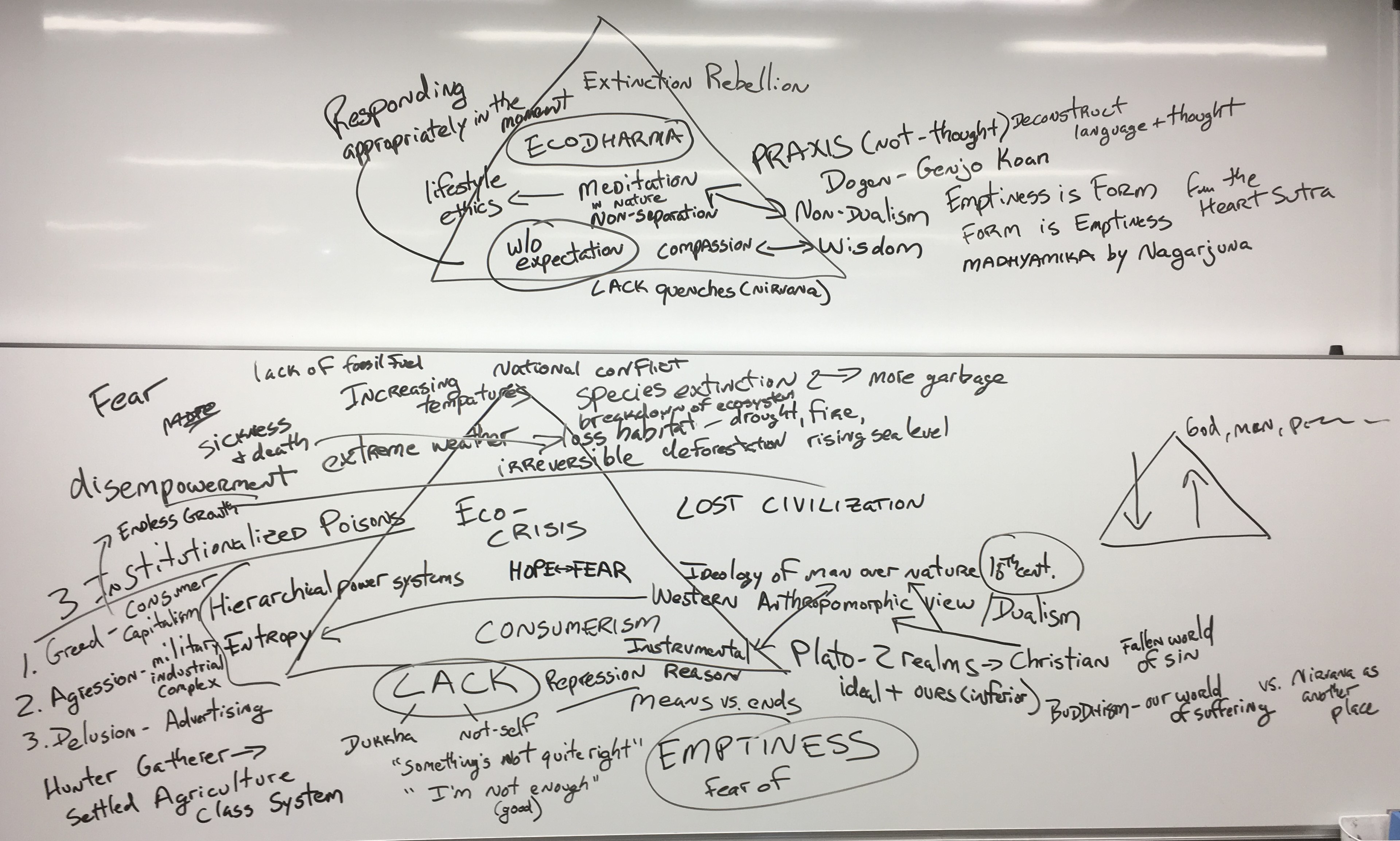
Class 2: The Nature of the Eco-Crisis and Its Causes
- Review of Iceberg of Dukkha
- open floor brainstorming on the nature of the eco-crisis
- Loy’s analysis of the eco-crisis
- students questions and conversation
Class 2: A Transformative Approach to the Eco-Crisis using Buddhist Teachings & Practice
- Presentation: The Diamond of Nirvana & Joanna Macy’s The Three Dimensions of the Great Turning
- Joanna Macy & The Great Turning
- Loy’s responses to the eco-crisis: 1) time/meditation in the natural world, to reconnect; 2) looking at the eco-implications of Buddhist teachings; 3) the bodhisattva/ecosattva Path, especially action without attachment to results.
- students questions and conversation
Homework for May 28: Submit a reflection on Unit 4
Unit 5: Science, Death, & Buddhism
May 28
Class 1: The Science of Dying & Meditation
- Group Discussion: What happens after death? Does the way you die affect what happens after death? Does suicide lead to hell or is it an escape from suffering in this world? Does science or religion offer the better explanation of how to deal with end of life?
- Presentation on Dying in the Three Yanas of Buddhism
- Video: The Tibetan Book of the Dead : A Way of Life
Class 2: Dying & Living in Contemporary Buddhism: The End-of-Life Care and Suicide Prevention Movements
- Presentation 1: Dying and Living in Contemporary Buddhism (complete lectures for both classes)
- Video: Rev. Jotetsu Nemoto and the power of meditation to face death
- Presentation 2: The Suicide Prevention Priests of Japan
- Video: The Francisco J. Varela Research Awards for Young Pioneers
- Final Reflection: “The World is on Fire”: In this age, there is so much suffering: both inner, as seen in rampant psycho-spiritual illness, and outer, as seen in religious-ethnic violence and the eco-crisis. As a young person coming of age in this world, how do you want to respond? Retreating from the world to meditate and gain liberation? Become an academic searching the new frontiers of knowledge? Becoming an activist and fighting for social justice? Raising a family and building a new world of interbeing?
Homework due May 31: Submit 1 page reflection on Unit 5 based on the Final Reflection question above
 Contemporary Buddhism in Japan & Asia